


Common Myths About Lithium Polymer Batteries
In the age of portable electronics, the Lithium Polymer (LiPo) battery has become as ubiquitous as the silicon chip. It powers the smartphone in your pocket, the laptop on your desk, and the drone filming your vacation. Yet, despite its widespread adoption, LiPo technology remains shrouded in a fog of misinformation. Myths born in the era of Nickel-Cadmium (NiCd) rechargeable batteries in the 1990s still persist today, confusing consumers and even some engineers.
At Hanery, we believe that misinformation is a safety hazard. As a seasoned Chinese manufacturer producing millions of polymer lithium batteries, 18650 packs, and Lithium Iron Phosphate (LiFePO4) solutions annually, we see the real-world consequences of these myths. We see good batteries discarded too early because of “memory effect” fears, and we see dangerous, swollen batteries kept in service because of “freezer fix” internet rumors.
This comprehensive guide is designed to clear the air. We will take ten of the most common myths about LiPo batteries and dismantle them using electrochemistry, physics, and data from our own R&D laboratories. Whether you are an Original Equipment Manufacturer (OEM) designing the next big gadget or a hobbyist looking to protect your gear, this is the definitive truth about the power source that runs your world.
Table of Contents
The “LiPo is Unsafe” Misconception
The Myth: LiPo batteries are unstable bombs that will spontaneously catch fire if you look at them wrong.
The Reality: While LiPo batteries store a tremendous amount of energy in a small package, they are chemically stable when manufactured correctly and used within their specifications. The reputation for danger comes largely from the early days of the technology (early 2000s) and from low-quality, “gray market” cells used in hobbyist RC applications without proper protection circuits.
Modern LiPo safety is a triumph of materials science.
- Ceramic Separators: At Hanery, we utilize ceramic-coated separators. In the past, a simple polyethylene sheet separated the anode and cathode. If the battery got hot, this sheet melted, causing a short circuit and fire. Ceramic coatings withstand temperatures up to 200°C, preventing internal shorts even under extreme thermal stress.
- Aluminum Packaging: The soft pouch design is actually a safety feature. If pressure builds up inside a rigid 18650 steel cylinder, it can become a pipe bomb if the safety vent fails. A LiPo pouch simply swells (“puffs”), giving a visual warning long before a catastrophic failure occurs.
- Failure Rates: In the consumer electronics sector, the failure rate of quality LiPo cells is less than 1 in 10 million. You are statistically more likely to be struck by lightning than to have a high-quality, BMS-protected LiPo battery spontaneously ignite in your pocket.
Charging Myths: The Ghost of "Memory Effect"
The Myth: You must fully discharge your battery to 0% before recharging it to prevent “memory effect,” or the battery will forget its capacity.
The Reality: This advice is 30 years out of date. The “memory effect” (voltage depression) was a specific characteristic of Nickel-Cadmium (NiCd) and, to a lesser extent, Nickel-Metal Hydride (NiMH) batteries. Lithium chemistries do not have a memory effect.
In fact, treating a LiPo like a NiCd battery is the fastest way to kill it.
- Partial Charging is Good: You can plug your phone or drone in at 40%, charge it to 80%, and unplug it. This “micro-cycling” puts less stress on the chemical structure than a deep 0-100% cycle.
- The Deep Discharge Danger: Intentionally draining a LiPo to 0% (0V) is destructive. If the voltage drops below roughly 3.0V per cell, the electrolyte begins to break down, and the copper current collector on the anode can dissolve. When you try to recharge it, that dissolved copper precipitates as sharp dendrites, causing internal shorts.
Hanery Advice: Charge whenever it is convenient. Avoid deep discharges whenever possible. The “memory” myth is not just wrong; it is harmful.
Storage Misunderstandings
The Myth: “I should store my battery fully charged so it’s ready to go,” OR “I should store it empty for safety.”
The Reality: Both extremes are damaging. Storage is a battle against two forces: Oxidation (at high voltage) and Decomposition (at low voltage).
- Storing at 100% (4.2V): When a LiPo sits at maximum voltage, the electrolyte is under high electrical stress. It begins to oxidize against the cathode, creating gas (swelling) and increasing internal resistance. A battery stored at 100% for a year in a hot warehouse will likely lose 20-30% of its capacity permanently.
- Storing at 0% (3.0V): All batteries suffer from self-discharge (about 1-3% per month). If you store a battery at the absolute bottom of its range, self-discharge will push it below the critical 2.5V threshold within weeks, rendering the cell dead and dangerous to recharge.
The Goldilocks Zone: The ideal storage voltage is 3.80V to 3.85V per cell (roughly 40-50% charge). At this voltage, the lithium ions are evenly distributed between the anode and cathode, minimizing chemical stress. This is why every battery Hanery ships leaves our factory at ~3.8V.
Cycle Life Assumptions
The Myth: “My battery is rated for 500 cycles, so on cycle 501, it will die.”
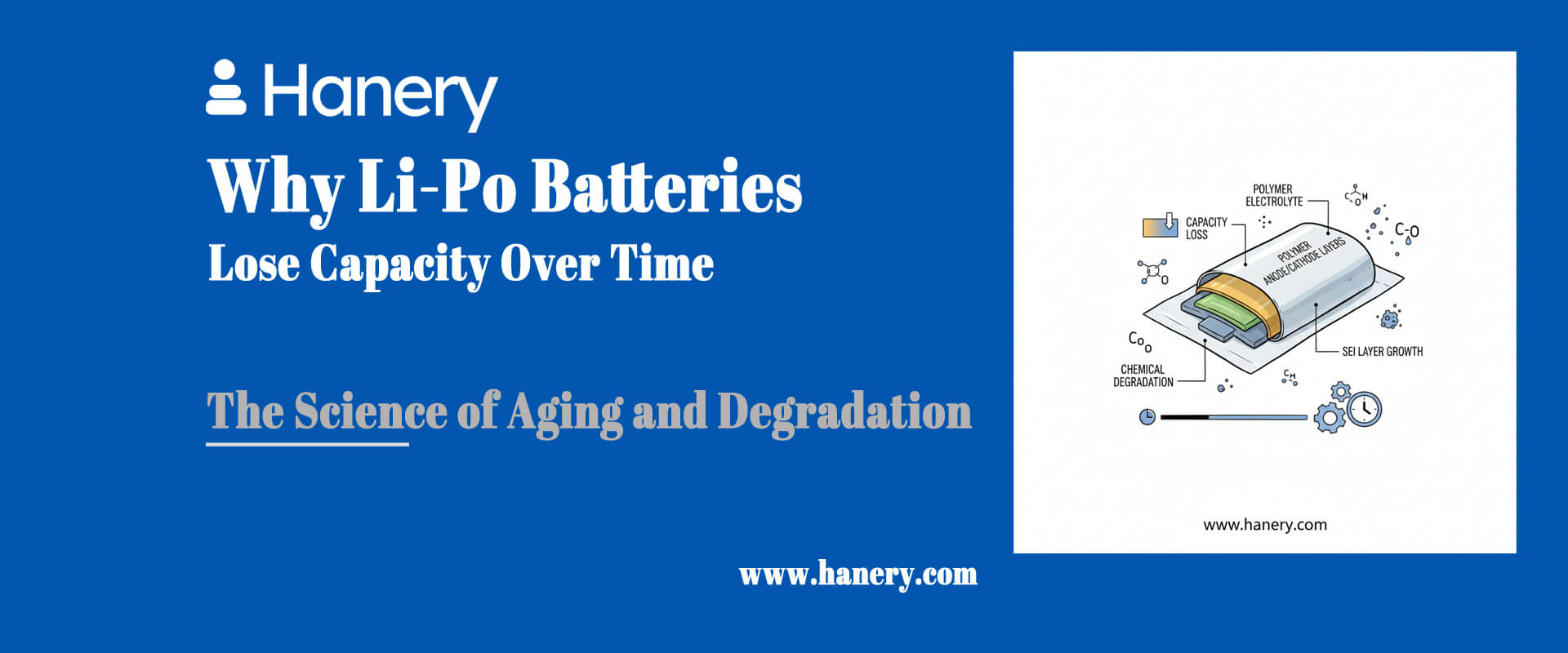
The Reality: Cycle life is not a countdown timer to death; it is a countdown to degradation. In the industry, “End of Life” (EOL) is standardly defined as the point where the battery retains only 80% of its original capacity.
- The Fade: A battery rated for 500 cycles will still work on cycle 501, and cycle 700. It will just hold less charge (e.g., 70% capacity) and have higher internal resistance (less “punch”).
- Depth of Discharge (DoD) Matters: The “500 cycles” rating assumes you are draining from 100% to 0% every time. If you only drain from 100% to 50% (50% DoD), you aren’t just getting 1,000 cycles; you might get 1,500 or 2,000 cycles. Shallow cycles dramatically reduce mechanical stress on the graphite anode, extending the total energy throughput of the battery.
Chart: Impact of Depth of Discharge on Total Cycle Life
| Depth of Discharge (DoD) | Estimated Cycle Life (to 80% capacity) |
|---|---|
| 100% DoD (Full drain) | 300 – 500 Cycles |
| 50% DoD (Half drain) | 1,200 – 1,500 Cycles |
| 10% DoD (Micro drain) | 4,000+ Cycles |
Swelling Myths: The "Freezer Fix"
The Myth: “If my battery puffs up, I can put it in the freezer to shrink it back down and fix it.”
The Reality: This is a dangerous internet myth. Swelling in a LiPo battery is caused by the generation of non-condensable gases (CO₂, CO, Hydrogen) due to electrolyte decomposition.
- The Freezer Effect: Putting a swollen battery in the freezer might temporarily shrink the gas volume (according to the Ideal Gas Law: PV=nRT, lower T means lower V). However, it does not reverse the chemical decomposition. The electrolyte is ruined. The moment the battery warms up, the gas expands again.
- Moisture Danger: Freezing a battery introduces condensation. Water inside a LiPo pack can cause external shorts on the protection circuit or corrosion on the tabs.
Hanery Warning: A swollen battery is a mechanically compromised pressure vessel. The internal layers are delaminating. There is no fix. It must be discharged and recycled immediately.
Voltage Confusion: 3.7V vs 4.2V
The Myth: “A 3.7V battery is less powerful than a 4.2V battery.”
The Reality: They are usually the exact same thing. This confusion stems from the difference between Nominal Voltage and Peak Voltage.
- Nominal Voltage (3.7V): This is the average voltage the battery delivers over a full discharge cycle. It is the number used for calculating Watt-hours (Wh).
- Peak Voltage (4.2V): This is the voltage of the battery when it is fully charged.
- Empty Voltage (3.0V): This is the cutoff point.
The Exception (LiHv): There is a relatively new technology called High-Voltage LiPo (LiHv). These cells utilize advanced electrolytes and cathode coatings that allow a Peak Voltage of 4.35V or 4.40V and a Nominal Voltage of 3.8V. These truly do pack about 10-15% more energy than standard LiPos, but they require compatible chargers.
C-Rate Misinterpretation
The Myth: “A 100C battery will force too much current into my device and fry it.”
The Reality: Electricity is pulled, not pushed. The C-rating represents the battery’s capability to deliver current, not the amount it forces out.
- The Water Pipe Analogy: Think of the battery as a water tank and the C-rating as the width of the pipe. A 100C battery has a massive pipe; a 20C battery has a narrow one. If your device (the faucet) only opens a little bit (draws 10 Amps), it doesn’t matter how big the pipe is—only 10 Amps will flow.
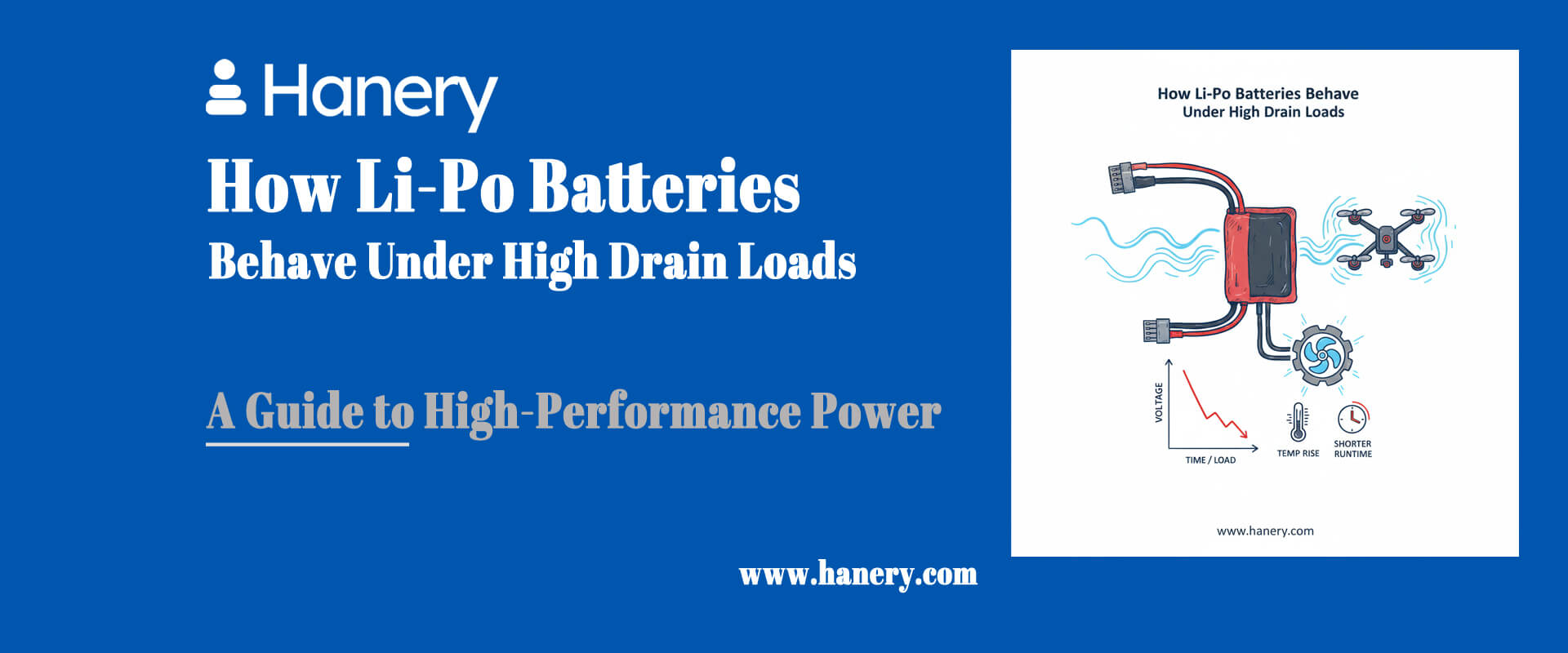
- The Benefit of Overhead: Using a battery with a higher C-rating than you need is actually beneficial. It means the battery will run cooler and have less voltage sag, because it isn’t working hard. The only downsides are cost and weight (high C-rate batteries are heavier due to thicker internal tabs).
The Fake Rating Problem: Be aware that in the hobbyist market, C-ratings are often wildly inflated. A sticker might say “100C,” but physics (internal resistance) suggests it’s really 30C. Hanery validates all C-ratings using sustained load temperature testing.
Fast-Charging False Claims
The Myth: “Fast charging doesn’t hurt the battery as long as it doesn’t get hot.”
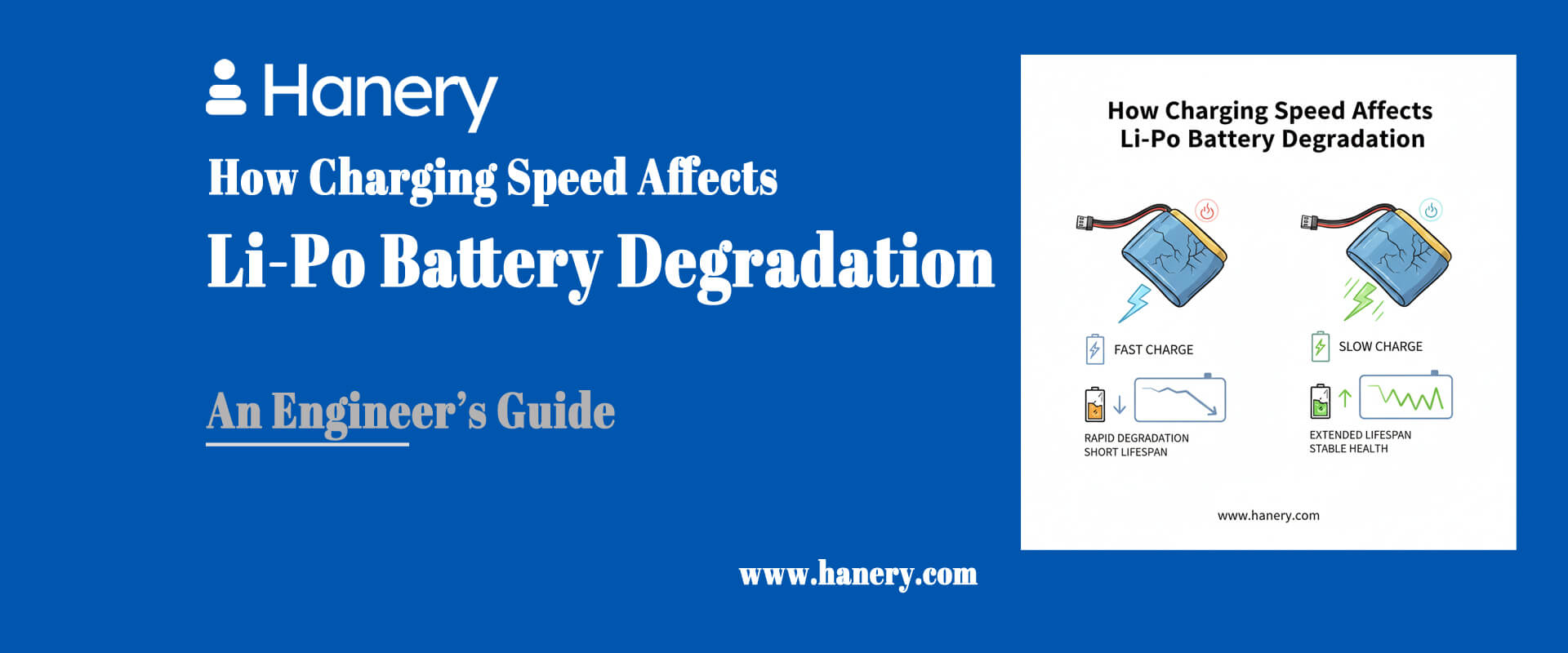
The Reality: Heat is not the only enemy; Lithium Plating is the silent killer of fast charging.
When you charge a battery at high speeds (e.g., 3C or 5C), you are forcing lithium ions to rush from the cathode to the anode.
- The Traffic Jam: The graphite anode has a limited rate at which it can accept these ions (intercalation). If the ions arrive faster than they can enter the graphite structure, they pile up on the surface.
- Metallic Plating: These piled-up ions turn into metallic lithium. This metal cannot be used for energy (loss of capacity) and can grow into sharp dendrites that puncture the separator (short circuit risk).
Even if the battery stays cool (due to active cooling), this plating can still occur, especially if the battery is older or the ambient temperature is cool. Fast charging always degrades a battery faster than slow (1C) charging.
Fire Risk Exaggerations
The Myth: “LiPo batteries catch fire randomly.”
The Reality: Spontaneous ignition in quality cells is virtually non-existent. LiPo fires are almost exclusively caused by User Error or Physical Abuse.
- Common Causes:
- Physical Puncture: Crashing a drone or piercing the pouch with a screwdriver.
- Overcharging: Using a NiMH charger setting on a LiPo battery (which doesn’t stop at 4.2V).
- Short Circuit: Poor soldering or damaged wires touching.
- Hanery Safety: Our cells undergo the “Nail Penetration Test” during QC. While the cell is destroyed, our safety standard dictates that it must not produce an open flame, even when punctured.
What Modern Engineering Has Solved
Many myths persist because they used to be true 15 years ago. Hanery’s modern engineering has solved many legacy issues.
- Puffing: Early LiPo electrolytes were unstable and gassed easily. Modern additives (like Vinylene Carbonate) create a stable Solid Electrolyte Interphase (SEI), making spontaneous puffing rare.
- Self-Discharge: Early lithium cells lost 5-10% charge per month. Modern Hanery cells lose less than 1-2% per month, meaning they can sit on a shelf for a year and still be functional.
- Temperature Tolerance: Old LiPos died at -10°C. Our specialized Low-Temperature formulations can now operate at 40°C, powering industrial equipment in arctic conditions.
Frequently Asked Questions
Is it true that I should break in a new LiPo battery?
Yes. While not strictly mandatory for safety, a gentle break-in (cycling 3-5 times at low discharge/charge rates) helps stabilize the SEI layer and ensures the electrolyte is fully distributed. This can improve performance for high-discharge packs.
Does leaving my phone plugged in overnight ruin the battery?
No. Modern devices have sophisticated Battery Management Systems (BMS) that cut off the current once the battery hits 100%. The phone runs off the wall adapter power, not the battery. However, keeping the battery at 100% voltage constantly (24/7) does accelerate aging, which is why “Optimized Battery Charging” features stop charging at 80% until morning.
Are 18650 batteries safer than LiPo pouches?
Mechanically, yes. The steel can of an 18650 protects against punctures better than a soft foil pouch. However, chemically, they are very similar. LiPos are used where weight and shape are more important than brute mechanical toughness.
Why does my battery say “Do Not Incinerate”?
Because lithium batteries are sealed pressure vessels containing flammable electrolytes. If thrown in a fire, the electrolyte boils, pressure builds, and the cell will explode, spraying burning lithium and chemicals.
Can I mix old and new batteries in a device?
No. Never mix old and new batteries in series or parallel. The old battery has higher internal resistance and lower capacity. It will discharge faster, potentially reversing polarity or overheating while the new battery is still working.
What is the “C-Rating” lie?
Many budget brands label batteries as “100C” when they are really 20C. A true 100C discharge would drain a battery in 36 seconds. If a battery claims 100C but has thin wires, it is a fake rating.
Does cold weather permanently damage LiPo batteries?
Running them in the cold usually just causes temporary voltage sag (sluggishness). However, charging them in freezing temperatures (below 0°C) causes permanent, dangerous lithium plating. Never charge a frozen battery.
Can I transport LiPo batteries on a plane?
Yes, but only in carry-on luggage. They are banned in checked baggage because if a fire starts in the cargo hold, automatic extinguishers might not stop it. You are also limited to batteries under 100 Watt-hours (Wh) without airline approval.
Is a swollen battery safe if it still holds a charge?
No. The fact that it works is irrelevant. The swelling means the internal layers have delaminated and the pressure inside is high. A small impact could cause the separator to shift, sparking an internal short and fire.
Why are Hanery batteries lighter than some competitors?
Sometimes, weight indicates quality (more active material). However, Hanery uses advanced stacking technology which eliminates the wasted space and packaging weight of older “wound” cells, offering higher energy density (more mAh per gram).
Summary & Key Takeaways
The Lithium Polymer battery is a marvel of modern engineering, but it is not magic. It is a chemical system governed by the laws of physics. By stripping away the myths of the past, we can see the clear path to safe, long-lasting performance.
- Safety is Built-In: Modern ceramic separators and BMS units make LiPo batteries incredibly safe when treated with respect.
- Chemistry has No Memory: Forget old charging habits. Charge early, charge often, and avoid the extremes of 0% and 100%.
- Storage is Key: The difference between a battery that lasts 1 year and 5 years is often just storage voltage (3.8V).
- Physics Don’t Lie: Understanding C-ratings and the dangers of fast charging allows you to spec the right battery for your OEM application.
At Hanery, we are committed to not just manufacturing batteries, but educating the world on how to use them. Our R&D teams are constantly pushing the boundaries of what is possible, creating cells that are safer, lighter, and more powerful than ever before. Whether you are building the next generation of robotics or simply powering your passion, trust the science, not the myths.
Ready to Power Your Innovation with Truth?
Don’t let misinformation limit your product’s potential. Partner with a manufacturer that prioritizes transparency, safety, and data-driven performance.
Reach out for a consultation on your custom battery needs. Let us help you select the perfect chemistry and form factor for your application, backed by the reliability of Hanery manufacturing.
Change log:
08/01/2026 Article posted.
27/03/2026 Added Related Artciles.
Factory-Direct Pricing, Global Delivery
Get competitive rates on high-performance lithium batteries with comprehensive warehousing and logistics support tailored for your business.
Contact Info
- info@hanery.com
- +86 13414472012
- https://www.hanery.com/
- A15 Building, No.6 Xinfeng Road, Longcheng Street, Longgang District, Shenzhen, China