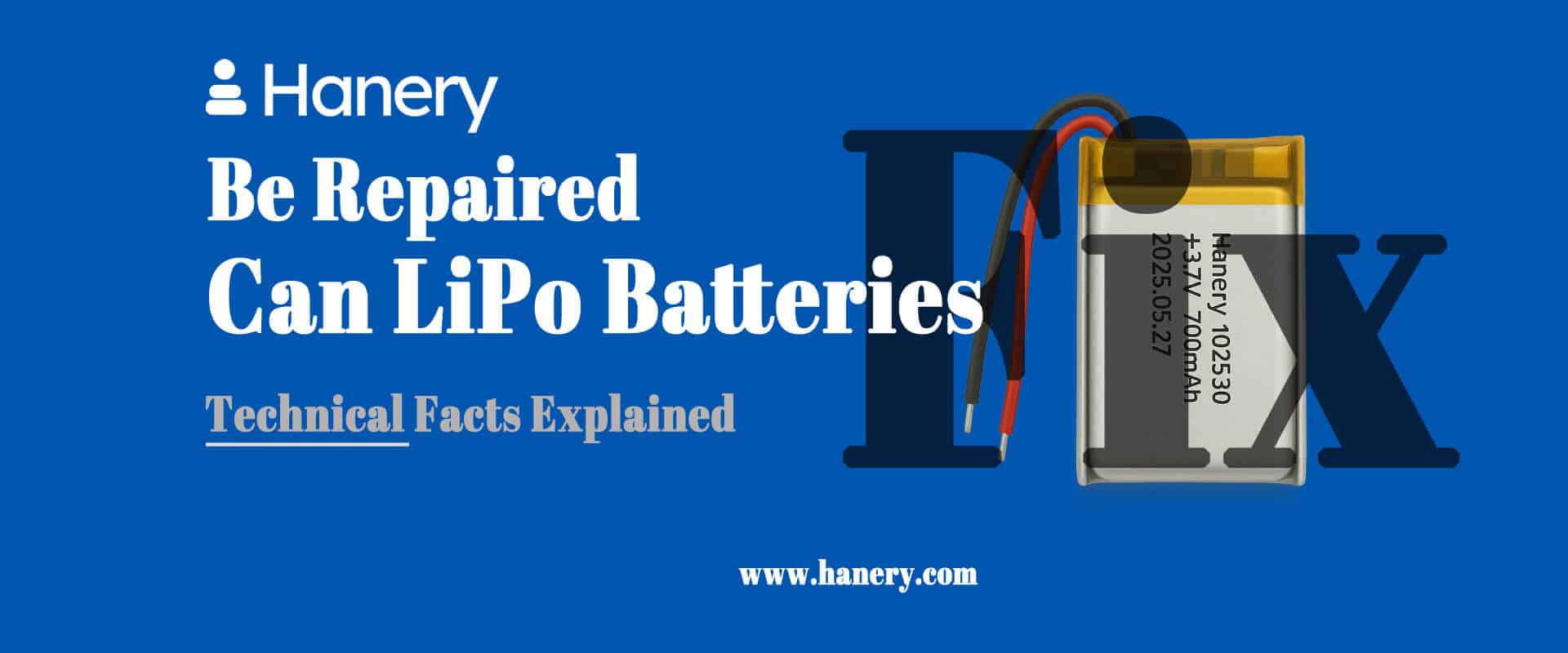


Can LiPo Batteries Be Repaired? Technical Facts Explained
In today’s throwaway culture, the urge to repair and reuse is a noble one. Whether you are a hobbyist trying to save a customized drone, an engineer maintaining a fleet of industrial robots, or a consumer with an expensive laptop, staring at a dead battery prompts a natural question: “Can I fix this?”
The internet is rife with videos and forums suggesting “hacks” to revive dead cells, shrink swollen packs, or solder new tabs onto lithium pouches. As a result, the line between a thrifty repair and a dangerous experiment has blurred.
At Hanery, we approach this question not just as a manufacturer, but as chemists and safety engineers. As a leading Chinese manufacturer specializing in polymer lithium batteries, 18650 packs, and Lithium Iron Phosphate (LiFePO4) solutions, we understand exactly how these energy vessels are built—and why they are designed to be sealed forever. We handle the raw volatility of lithium every day on our production lines, managing it with rigorous quality inspection certification and automated safety systems.
The short answer to “Can LiPo batteries be repaired?” is complex. Can you fix a broken wire? Yes. Can you fix the chemical cell itself? Absolutely not.
This comprehensive guide serves as the definitive technical resource on the subject. We will dissect the anatomy of a LiPo cell to explain why it is non-serviceable, debunk dangerous DIY myths like the “freezer fix,” and outline the very narrow set of circumstances where a professional repair (such as a BMS swap) might be feasible—and when it is time to let go.
Table of Contents
Why LiPo Cells Are Sealed: The Vacuum Imperative
To understand why you cannot open and fix a LiPo cell, you must understand how it is made. A Lithium Polymer cell is not a mechanical device like a motor; it is a chemical reactor sealed in a vacuum.
The Sensitivity to Moisture
The internal environment of a Hanery LiPo cell is strictly controlled. We manufacture our cells in “Dry Rooms” where the humidity is kept below 1% (dew point -40°C).
- The Reaction: Lithium salt (LiPF6) in the electrolyte reacts instantly with water molecules (H2O) in the air.
- The Result: This reaction creates Hydrofluoric Acid (HF). This acid is highly corrosive and toxic. It eats away at the internal cathode structure and the SEI layer on the anode.
If you were to cut open the aluminum pouch to “fix” an internal connection, the ambient moisture in your room would instantly begin destroying the chemistry. Within minutes, the cell would be chemically ruined, regardless of the mechanical repair you attempted.
The Vacuum Seal
Pouch cells are vacuum-sealed to ensure the electrode layers are pressed tightly together.
- Compression: This compression is vital for lowering internal resistance.
- Delamination: If the seal is broken, air enters, and the pressure is lost. The layers delaminate (separate). Electrons can no longer jump effectively between the anode and cathode. The internal resistance skyrockets, and the cell becomes dead weight.
Therefore, the cell enclosure is not just a wrapper; it is an active component of the battery’s functionality. Once breached, the battery is destroyed.
Puncture vs. Swelling Damage: Irreversible Failures
Two common scenarios prompt users to consider repair: physical damage (crashes/drops) and swelling (puffing). Both represent terminal failures.
Puncture Damage
If a drone crashes or a tool is dropped, the soft aluminum pouch might get nicked or pierced.
- The Micro-Short: Even if the battery doesn’t catch fire immediately, a dent often presses the anode and cathode layers together through the thin separator. This creates a “soft short.”
- The Slow Burn: This short circuit will slowly drain the battery, generating heat. Attempting to “patch” the hole with tape does nothing to fix the internal short. The battery is now a fire hazard and cannot be repaired.
Swelling (The "Puff")
Swelling is caused by the decomposition of the liquid electrolyte into gas (CO₂, CO, Hydrogen).
- The Mechanism: This happens due to overcharging, overheating, or aging. The gas pushes the layers apart.
- Why It’s Fatal: You cannot simply “let the gas out.” The gas is the physical matter of the electrolyte that has changed state. That electrolyte is now gone. The battery has permanently lost chemical capacity. Puncturing the pouch to release the gas (a common internet myth) introduces oxygen and moisture, creating a high risk of immediate fire.
PCB/BMS Repair vs. Cell Repair: The Exception
While the cell (the silver pouch) cannot be repaired, the pack (the assembly) sometimes can be. This distinction is critical.
A battery Pack consists of:
- Cells: The chemical energy storage.
- BMS/PCM: The protection circuit board.
- Wires/Connectors: The interface.
Reparable Components
- Broken Wires: If the main discharge wire (e.g., the silicone wire leading to the connector) is cut or the connector (XT60) is melted, this can be repaired by soldering on a new connector. Note: This requires extreme caution to avoid shorting the wires during the process.
- Faulty BMS: Sometimes, a battery “dies” because the BMS board has failed (e.g., a blown MOSFET), but the cells inside are still healthy (balanced and at 3.8V). A skilled technician can desolder the old BMS and spot-weld a new one in place.
The Hanery Warning
While BMS replacement is physically possible, it requires specialized equipment (spot welder). Soldering directly to battery tabs is dangerous because the heat travels into the cell, melting the separator.
Professional Risk Factors: Why Shops Refuse
You may notice that very few electronics repair shops will agree to repair a LiPo battery. They will happily replace the screen or the charging port, but if the battery is damaged, they mandate a full replacement. This is due to liability and safety.
Thermal Runaway in the Shop
If a technician accidentally shorts the tabs of a 5000mAh LiPo while trying to replace a BMS, the battery can enter thermal runaway instantly.
- The Fire: A lithium fire is self-oxidizing (it creates its own oxygen). It cannot be smothered easily. It burns at over 1,000°C.
- The Liability: No repair shop wants to risk burning down their facility to save a customer $50 on a battery.
Unknown Internal Health
Even if a technician fixes a broken wire, they cannot see inside the cell. The impact that broke the wire might have also bruised the internal separator. If they return the “repaired” battery to you, and it catches fire a week later due to that internal bruise, they are liable. It is simply not worth the risk.
Why Repair Is Not Recommended: The Economics
At Hanery, we design batteries for manufacturability and reliability, not for serviceability. The economics of repair rarely make sense.
The Cost of Failure
Imagine you have a $2,000 photography drone. The battery costs $150.
- Scenario: You crash, damaging the battery connector. You attempt a DIY repair.
- Risk: If your solder joint fails mid-flight due to vibration, the drone loses power and falls from the sky. You have risked $2,000 to save $150.
The "weakest Link" Theory
In a multi-cell pack (e.g., 4S), if one cell dies, some people try to replace just that single cell.
- The Mismatch: The new cell will have 100% capacity and low internal resistance. The three old cells have 80% capacity and high resistance.
- The Outcome: During use, the old cells will drain faster and heat up more than the new cell. The BMS will struggle to balance them. The pack will perform poorly and likely fail again within weeks.
OEM Replacement Practices
How do major Original Equipment Manufacturers handle battery issues?
Swap, Don't Fix
If you send a laptop with a bad battery to the manufacturer, they do not open the battery casing. They remove the entire battery unit and recycle it. They install a fresh, factory-tested unit.
Hanery’s Warranty Policy
Like most reputable manufacturers, Hanery’s warranty covers defects in materials and workmanship. However, the warranty is void if the battery casing is opened or if there is evidence of attempted repair.
- Reasoning: Once the factory seal is broken, we can no longer guarantee the safety mechanisms (like the pressure balance or moisture seal) are intact.
What Can Be Salvaged?
If you have a dead pack that cannot be repaired, is it total waste? Not necessarily. Hobbyists and eco-conscious users often salvage parts before recycling the cells.
- Connectors: High-quality connectors like XT60, XT90, or EC5 are durable. You can snip them off (one wire at a time!) and reuse them for other projects.
- Silicone Wire: The high-strand-count silicone wire used on battery leads is expensive and useful for hobby electronics.
- Balance Leads: The JST-XH balance plugs can be harvested.
- BMS Board: If you confirm the cells died but the BMS is fine, you can keep the BMS for testing or DIY projects (provided you have the skills to re-wire it).
Crucial Step: Once the useful peripherals are removed, the chemical cells themselves must be taped up and recycled.
DIY Misconceptions: Myths That Danger Lives
The internet is a dangerous place for battery advice. Here are the top three myths we see at Hanery that need to be debunked.
Myth 1: "The Freezer Fix"
- The Idea: Putting a swollen battery in the freezer shrinks the gas, “fixing” the puff.
- The Truth: It only temporarily reduces the volume of the gas (Ideal Gas Law). It does not reverse the chemical decomposition of the electrolyte. As soon as it warms up, it re-expands. Plus, moisture from the freezer can cause shorts.
Myth 2: "Pin-Prick Venting"
- The Idea: Poking a small hole in the pouch to let the gas out, then taping it shut.
- The Truth: This is incredibly dangerous. The gas is flammable. The escaping gas can ignite from a static spark. Furthermore, you are letting oxygen in, which reacts with the lithium to generate heat. You are also exposing the internal chemistry to moisture (hydrofluoric acid risk).
Myth 3: "Zapping" a 0V Cell
- The Idea: Using a NiMH charger to force voltage into a dead (0V) LiPo to “wake it up.”
- The Truth: If a LiPo is at 0V, copper dendrites have likely grown inside. Forcing current into it can cause a direct internal short circuit, leading to an explosion. A 0V lithium cell is dead forever.
Safety Risks of Attempting Repair
If you insist on attempting a repair (e.g., soldering a connector), you must understand the “Fire Triangle” you are working with.
- Fuel: The electrolyte and lithium are the fuel.
- Oxygen: The cathode releases oxygen when overheated.
- Heat: Your soldering iron provides the heat.
The Thermal Bridge
Tabs on LiPo batteries are made of aluminum (positive) and nickel (negative). They are excellent heat conductors.
- The Hazard: When you apply a soldering iron to the tab, that heat travels instantly into the pouch. It can melt the polymer separator right where the tab enters the cell.
- Prevention: You must use a heat sink (like a metal alligator clip) clamped between the solder joint and the cell body to divert the heat.
Inhalation Risk
If a repair goes wrong and the battery vents, it releases white smoke. This smoke contains heavy metals and toxic gases. Inhaling it can cause permanent lung damage. Repair should only be attempted in a well-ventilated area or outdoors, never in a bedroom or office.
Proper End-of-Life Steps
When repair is impossible (which is 99% of the time for the cells themselves), responsible disposal is the final step.
The Saltwater Bath Debate
For years, hobbyists used saltwater to discharge batteries.
- The Logic: Salt water is conductive; it drains the battery to 0V slowly.
- The Issue: Electrolysis corrodes the tabs off before the battery is fully drained, leaving a partially charged battery in a bucket of sludge.
- Hanery Recommendation: It is better to use a dedicated “discharger” (like a light bulb or a resistor bank) to drain the battery to 0V in a controlled dry environment.
Taping and Recycling
- Discharge: Drain the battery as low as safely possible.
- Insulate: Cut the wires (one at a time) and tape over the exposed metal terminals with electrical tape. This prevents shorts in the recycling bin.
- Drop-off: Take the battery to a certified e-waste center or a hardware store with a battery bin (e.g., Call2Recycle). Never throw lithium batteries in the household trash; they cause fires in garbage trucks.
Chart: Repair vs. Replace Decision Matrix
| Symptom | Diagnosis | Recommended Action |
|---|---|---|
| Swollen / Puffy | Electrolyte Decomposition | RECYCLE IMMEDIATELY. Do not attempt repair. |
| Punctured / Dented | Internal Short Risk | RECYCLE IMMEDIATELY. Fire hazard. |
| 0 Volts Reading | Deep Discharge / Copper Corrosion | RECYCLE. Do not attempt to recharge. |
| Broken Connector | Mechanical Failure | REPAIRABLE. Solder new connector (Caution required). |
| Cut Wire | Mechanical Failure | REPAIRABLE. Solder/Splice wire (Caution required). |
| Rapid Drain | High Internal Resistance (Aging) | RECYCLE. Cannot be fixed. |
Frequently Asked Questions
Can I replace just one cell in a 6S battery pack?
Technically yes, but practically no. Mixing a new cell with 5 old cells creates an imbalanced pack. The old cells will drag the new one down. It is safer and more reliable to buy a new pack.
Is it safe to solder directly to a LiPo tab?
It is very risky. Aluminum tabs require specialized flux to solder, and the heat can easily melt the cell seal. Manufacturers use spot welding (ultrasonic or resistance) which generates no heat. We do not recommend soldering tabs at home.
Why does Hanery not sell replacement BMS boards for my specific battery?
BMS boards are usually custom-designed for the specific shape and current rating of the pack. Selling them separately encourages dangerous DIY repairs that we cannot oversee or guarantee safety for.
If my battery is just a “little” puffy, can I still use it?
We advise against it. “A little” puffy means the chemistry has already failed. It might work for a few more cycles, but the internal resistance is higher, and the risk of sudden expansion or fire during charging is significantly elevated.
Can I use electrical tape to fix a nick in the battery wire?
Yes. If the copper wire itself is intact and only the silicone insulation is nicked, wrapping it in high-quality electrical tape or heat shrink is a safe and acceptable repair.
What is the shelf life of a dead LiPo?
A LiPo at 0V is chemically unstable. It should not be stored. It should be recycled as soon as possible. A healthy LiPo at storage voltage (3.8V) can be stored for years.
Does Hanery offer a recycling program?
As a B2B manufacturer, we work with our OEM partners to manage large-scale recycling. For individual consumers, we recommend using local municipal e-waste programs which are better equipped for local collection.
Can a BMS fail without the battery failing?
Yes. Sometimes a moisture short or a voltage spike destroys the BMS chips, while the cells remain healthy. In this rare case, a professional battery technician could replace the BMS to save the expensive cells.
Why do my batteries puff up when I don’t use them?
If stored fully charged (4.2V), the electrolyte oxidizes over time, creating gas. This is why storage voltage (3.8V) is so critical. A battery can ruin itself sitting on a shelf if stored improperly.
Is it expensive to have a professional build a custom pack?
Custom pack assembly (spot welding cells) is a service offered by some specialized hobby shops. It is more expensive than buying a mass-produced pack, but cheaper than buying the spot-welding equipment yourself.
Summary & Key Takeaways
The question of repairing LiPo batteries ultimately comes down to a balance of Cost vs. Safety. While mechanical issues like broken wires or connectors are repairable by those with the right skills, the chemical core of the battery—the cell itself—is a sealed system that cannot be serviced.
- The Cell is Sacred: Once the silver pouch is compromised (swollen, punctured, or dead), there is no turning back.
- The BMS is the Brain: Electronics failure is the only scenario where “surgery” on a pack makes sense, but only if performed by a professional.
- Safety Over Savings: Never risk a house fire or a destroyed device to save the cost of a replacement battery.
- Myths are Dangerous: Ignore the “freezer tricks” and “venting hacks.” They are based on bad science and create immediate hazards.
At Hanery, our commitment to quality manufacturing ensures that our batteries are built to last, minimizing the need for repairs. We utilize advanced stacking technology, high-purity electrolytes, and robust protection circuits to deliver energy you can trust. When a battery eventually reaches the end of its life, we advocate for responsible recycling to pave the way for the next generation of power.
Reliable Power, No Repair Needed
Are you an OEM looking for battery solutions that prioritize longevity and safety? Tired of dealing with high failure rates?
Reach out for a consultation on our high-reliability battery packs, designed to keep your devices running longer, so you never have to ask “Can I fix this?”
Change log:
12/01/2026 Article posted.
27/03/2026 Added Related Artciles.
Factory-Direct Pricing, Global Delivery
Get competitive rates on high-performance lithium batteries with comprehensive warehousing and logistics support tailored for your business.
Contact Info
- [email protected]
- +86 13414472012
- https://www.hanery.com/
- A15 Building, No.6 Xinfeng Road, Longcheng Street, Longgang District, Shenzhen, China