
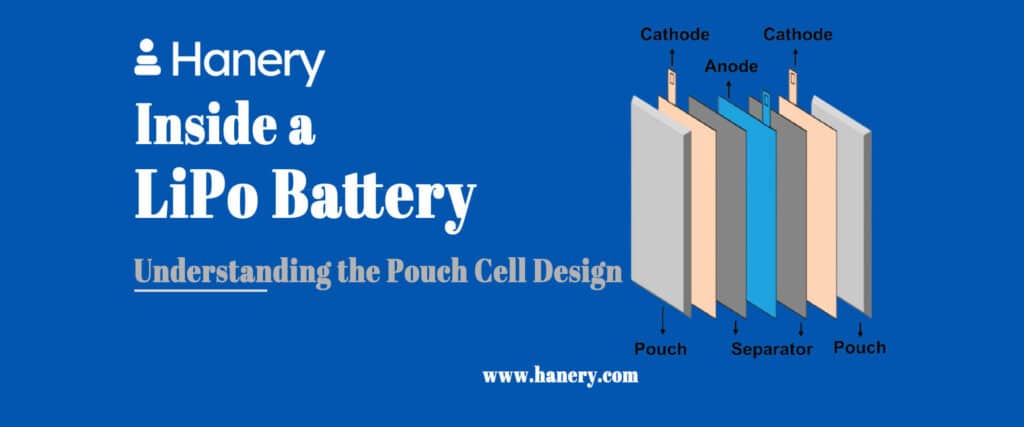
Inside a LiPo Battery: Understanding the Pouch Cell Design
In the competitive landscape of modern electronics, the constraints of the “black box” battery often dictate the final form of the device. Designers of ultra-slim laptops, folding smartphones, and aerodynamic drones cannot afford the wasted space of rigid steel cylinders. They require a power source that is flexible, lightweight, and capable of filling every available cubic millimeter of the device chassis. The solution to this engineering challenge is the Lithium Polymer (LiPo) Pouch Cell.
At Hanery, we do not view the pouch cell merely as a battery; we view it as a triumph of materials science. Unlike the 18650 cylindrical cell—which acts like a pressure vessel—the pouch cell is a vacuum-sealed laminate architecture that relies on chemical stability rather than mechanical containment. As a leading Chinese manufacturer specializing in polymer lithium batteries, 18650 packs, and Lithium Iron Phosphate (LiFePO4) solutions, Hanery utilizes advanced “Stacking” (Z-fold) technology to produce cells that offer superior energy density and thermal management compared to traditional wound cells.
This comprehensive guide will take you inside the foil. We will peel back the layers of a Hanery pouch cell to reveal the sophisticated interplay of anodes, cathodes, and ceramic-coated separators. We will explain why this architecture dominates the consumer electronics market and how recent 2024-2025 advancements in silicon anodes and semi-solid electrolytes are pushing the boundaries of what these cells can achieve.
Table of Contents
Pouch Cell Anatomy: Beyond the Foil
To the naked eye, a LiPo battery looks like a simple silver bag. However, this “bag” is a highly engineered composite structure designed to hold volatile chemistry under vacuum for years. The pouch cell consists of a repeating stack of three primary components: the Cathode (positive electrode), the Anode (negative electrode), and the Separator, all bathed in a liquid or gel electrolyte.
The External Case: Aluminum Laminate Film
The silver skin of the battery is not just household aluminum foil. It is a multi-layer composite film, typically 85µm to 150µm thick, engineered to be electrically insulating on the outside and chemically resistant on the inside.
- Outer Layer (Nylon/PET): A durable plastic layer (Polyethylene Terephthalate) that prevents tears and provides electrical insulation.
- Middle Layer (Aluminum Foil): A solid barrier against moisture. Even a microscopic amount of water vapor entering the cell will react with the lithium to create hydrofluoric acid (HF), destroying the battery.
- Inner Layer (Polypropylene – PP): A specialized plastic that creates the heat seal. It must not react with the harsh electrolyte inside.
The Internal "Jelly Roll" vs. Stack
Inside this casing, the active materials are arranged. While some cheap pouch cells use a flattened “jelly roll” (winding), Hanery’s premium cells utilize Z-Stacking. Individual sheets of anode and cathode are stacked alternately with a separator weaving between them in a Z-pattern. This structure maximizes the active surface area and provides a direct path for heat to escape.
Separator Materials: The Silent Guardian
The separator is a thin, microporous membrane placed between the anode and cathode. Its job is contradictory: it must physically keep the electrodes apart (to prevent a short circuit) while freely allowing lithium ions to pass through.
Polyethylene (PE) vs. Polypropylene (PP)
Standard separators are made of PE or PP plastic, often less than 16µm thick.
- Shutdown Mechanism: If the cell overheats, a PE separator is designed to melt and close its pores, stopping the flow of ions and shutting down the cell before it catches fire.
The Ceramic Revolution
In high-performance Hanery cells, we use Ceramic Coated Separators (CCS).
- Composition: A base layer of PE is coated with microscopic Alumina (Al₂O₃) or Boehmite particles.
- Benefit: Standard PE shrinks significantly at 130°C, leading to electrode contact. Ceramic-coated separators maintain their shape and integrity up to 200°C or higher. This thermal stability is critical for passing safety tests like the “Hot Box” and nail penetration.
Electrode Layering: The Chemistry of Power
The electrodes are where the energy is stored. They are coated onto thin metal foils that act as current collectors.
The Cathode (Positive)
- Current Collector: Aluminum Foil (~12-15µm thick).
- Active Material: A slurry of Lithium Cobalt Oxide (LCO) for high capacity, or Nickel Manganese Cobalt (NMC) for high discharge rates, mixed with a binder (PVDF) and conductive carbon.
- Hanery Process: We use automated coating machines to apply this slurry with micron-level precision. Uneven coating leads to “hot spots” where current concentrates, causing degradation.
The Anode (Negative)
- Current Collector: Copper Foil (~6-10µm thick).
- Active Material: Primarily Graphite. However, in our newest high-energy cells, we use Silicon-Carbon composites.
- The Silicon Advantage: Silicon can theoretically hold 10 times more lithium ions than graphite. By doping the anode with silicon, we increase the cell’s capacity without increasing its size.
Why Pouch Cells Save Space
The primary driver for the adoption of LiPo technology is Volumetric Energy Density—how much energy fits in a specific space.
Packaging Efficiency
- Cylindrical Cells: When you pack round 18650 cells together, there are inevitable air gaps between them. The packaging efficiency is roughly 78%.
- Pouch Cells: Rectangular pouch cells can be stacked flush against each other with zero air gaps. The packaging efficiency approaches 95%.
The "Dead Weight" Factor
Cylindrical cells require a heavy steel can and a pressure vent mechanism. Pouch cells eliminate this dead weight, replacing it with the lightweight aluminum laminate film. This results in a pouch cell being roughly 20% lighter than a cylindrical cell of equal capacity, a critical factor for drones and handheld devices.
Comparison with Cylindrical Cells
While pouch cells offer density, cylindrical cells (like the 18650 and 21700) are famous for their mechanical durability. Here is how they compare in an OEM context:
| Feature | LiPo Pouch Cell | Cylindrical (18650/21700) |
|---|---|---|
| Casing | Soft Aluminum Foil | Rigid Steel/Nickel |
| Form Factor | Fully Customizable (Any L x W x H) | Fixed Dimensions (18mm x 65mm) |
| Energy Density | High (200-260 Wh/kg) | Moderate (150-220 Wh/kg) |
| Internal Resistance | Very Low (High Discharge) | Moderate |
| Safety Vent | Seam rupture (Puffing) | Mechanical CID/Vent |
| Pressure Tolerance | Low (Needs external compression) | High (Self-contained) |
Verdict: Choose cylindrical for durability (power tools, Teslas). Choose pouch (Hanery LiPo) for lightweight, compact integration (smartphones, tablets, drones).
Heat Dissipation in Pouch Format
Heat is the enemy of battery longevity. One of the hidden advantages of the pouch format is its Surface Area to Volume Ratio.
The Cooling Advantage
A cylindrical cell traps heat in its center core. The heat must travel through layers of winding to reach the surface. In contrast, a pouch cell is flat and wide. The distance from the center of the cell to the cooling surface is often only 3-5mm.
- Result: Pouch cells shed heat significantly faster during high-discharge events (like a drone takeoff).
- Tab Cooling: Hanery utilizes wide “multipole” tabs in our high-discharge cells. Since the tabs are connected to every single sheet of the stack, they act as heat pipes, pulling thermal energy out of the core and into the external busbars.
Durability and Vulnerability
The soft nature of the pouch cell is its greatest weakness. Without a steel shell, the cell is vulnerable to mechanical trauma.
The Puncture Risk
A sharp object can easily pierce the aluminum laminate.
- Consequence: If the pouch is pierced, moisture enters, reacting with the lithium. Simultaneously, the layers may short circuit, causing a fire.
- Hanery Solution: For robotic or industrial applications, we encase our pouch cells in hard ABS plastic or fiberglass composite frames to provide the necessary armor.
The Swelling Phenomenon
Pouch cells swell as they age or if abused (overcharged).
- Design Consideration: OEMs must design their device cavity to allow for 10% expansion over the battery’s life. If the cavity is too tight, the swelling battery can crack the device screen or housing.
Protective Coatings and Safety Layers
Safety is not just about the separator; it is integrated into the electrode materials themselves.
Anode/Cathode Coatings
Hanery applies nanometer-thick coatings to the cathode particles.
- Function: This coating prevents the electrolyte from reacting directly with the cathode at high voltages (4.4V+), reducing gas generation and allowing for higher voltage charging without swelling.
The "Shut-down" Tab
In some advanced designs, the positive tab includes a polymer layer that increases resistance as temperature rises. If the tab gets too hot due to a short circuit, this layer becomes non-conductive, cutting off the current flow essentially like a resettable fuse.
Manufacturing Insights: The Hanery Process
Producing a high-quality pouch cell is a delicate dance of chemistry and precision mechanics. Here is a glimpse into the Hanery factory floor:
- Slurry Mixing: Active materials are mixed in a vacuum mixer to ensure zero bubbles.
- Coating: The slurry is coated onto large rolls of copper and aluminum foil. The thickness is controlled to within ±1 micron.
- Calendering: The coated foils are pressed between massive steel rollers. This compresses the material to increase energy density and ensure electrical contact.
- Slitting and Stacking: The rolls are cut into sheets. Robots stack the anode, separator, and cathode sheets with perfect alignment.
- Tab Welding: Ultrasonic welders attach the aluminum and nickel tabs to the stack.
- Pouch Forming: The stack is placed into the pre-formed aluminum laminate pocket.
- Electrolyte Filling: The cell is filled with liquid electrolyte in a dry room (humidity <1%).
- Formation and Aging: The cell is charged for the first time (Formation) to create the SEI layer, then aged for 7-14 days to check for defects.
Improvements in New Generation Cells
The technology inside the pouch is evolving rapidly.
Semi-Solid State Electrolytes
Hanery is currently deploying semi-solid electrolytes in high-end cells. By turning the liquid electrolyte into a gel or semi-solid paste, we reduce the risk of leakage and improve thermal stability. These cells can pass the nail penetration test without catching fire.
Silicon-Carbon Anodes
Advances in electrode materials (such as high-capacity cathodes or silicon-rich anodes) may push LiPo’s energy density higher, potentially reaching or exceeding some Li-ion benchmarks — though managing safety, IR, and cycle stability remains challenging.
Flexible & Custom Form Factors
By 2026, silicon-doped anodes have become standard for flagship devices. This technology allows us to push energy density toward 300 Wh/kg and 700 Wh/L, significantly outperforming traditional graphite-only cells.
Fast-Charge Structures
New electrode designs feature “high porosity” channels laser-drilled into the graphite. This allows lithium ions to enter the anode faster, enabling 5C or 10C charging (0-80% in 10 minutes) without the risk of lithium plating.
Frequently Asked Questions
Can I repair a punctured pouch cell?
No. Never attempt to tape or seal a punctured cell. Once the seal is broken, moisture enters and reacts with the lithium, creating hydrofluoric acid. The cell is chemically compromised and is a fire hazard. Recycle it immediately.
Why do Hanery cells use “Z-Stacking” instead of winding?
Stacking allows for lower internal resistance because each layer has its own connection to the tab (multipole). Winding forces electricity to spiral through the whole roll. Stacking also utilizes the corner space of the pouch better, increasing capacity.
What is the shelf life of a new pouch cell?
If stored at storage voltage (3.8V) and room temperature, a Hanery pouch cell can be stored for 3-5 years. However, we recommend a refresh cycle every 6-12 months to ensure the electrolyte remains distributed.
Why is the aluminum pouch electrically insulated?
The outer nylon layer is insulating, but the middle aluminum layer is conductive. If the outer layer is scratched and touches a metal device chassis, it can cause a ground loop or short. This is why we verify the insulation resistance of the pouch during QC.
Do pouch cells have a safety valve?
They do not have a mechanical valve like cylindrical cells. The seal of the pouch itself acts as the valve. If pressure builds up, the seam at the edge of the battery will split open to release the gas, preventing a violent explosion.
Is it safe to bend a pouch cell?
No. While they look flexible, the internal electrode layers are brittle. Bending the cell can crack the electrode coating or tear the separator, causing an internal short circuit. However, Hanery manufactures custom curved cells that are fixed in a curved shape during production for wearables.
Why are pouch cells more expensive than 18650s?
The manufacturing process for stacking is slower and more complex than winding. Additionally, the aluminum laminate film is a specialized, expensive material, whereas steel cans are cheap commodities.
Can I solder directly to the battery tabs?
We strongly advise against it. The heat from a soldering iron travels instantly into the cell, melting the polymer seal and separator. Tabs should be spot welded or laser welded. If you must solder, you must use a heat sink clip between the solder point and the cell body.
What is the “formation” process mentioned in manufacturing?
Formation is the first charge of the battery. It is a controlled process that creates the Solid Electrolyte Interphase (SEI) layer on the anode. A stable SEI layer is crucial for the battery’s long-term cycle life.
Are solid-state pouch cells available now?
“Semi-solid” or “hybrid” solid-state cells are available and manufactured by Hanery for specific high-end applications (like drones). True all-solid-state batteries are still in the early commercialization phase due to high costs.
Summary & Key Takeaways
The LiPo pouch cell is a marvel of efficiency, trading the heavy armor of the past for the lightweight, high-performance materials of the future. It is a system where every layer—from the ceramic-coated separator to the silicon-doped anode—plays a critical role in safety and energy delivery.
- Anatomy of Efficiency: Stacking technology and flexible laminate cases allow pouch cells to achieve 95% volumetric efficiency, far surpassing cylindrical cells.
- Material Science: The use of ceramic separators and advanced electrolytes allows Hanery cells to withstand higher temperatures and faster charging rates than ever before.
- Vulnerability: The trade-off for this performance is physical fragility. OEMs must design robust housings to protect the cell from punctures and allow for natural swelling.
- Future Proof: With the integration of silicon anodes and semi-solid electrolytes, the pouch format is the vessel that will carry battery technology into the next decade of innovation.
At Hanery, we are dedicated to pushing the boundaries of what is possible inside that silver foil. Whether you need a micro-cell for a smart ring or a high-voltage pack for an eVTOL, our R&D team understands the complex interplay of materials required to bring your vision to life.
Ready to Optimize Your Energy Density?
Don’t let wasted space limit your product’s potential. Partner with a manufacturer that masters the art of the pouch cell.
Reach out for a consultation on custom-sized, stacked LiPo cells designed specifically for your device’s unique geometry and power requirements.
Factory-Direct Pricing, Global Delivery
Get competitive rates on high-performance lithium batteries with comprehensive warehousing and logistics support tailored for your business.
Contact Info
- info@hanery.com
- +86 13414472012
- https://www.hanery.com/
- A15 Building, No.6 Xinfeng Road, Longcheng Street, Longgang District, Shenzhen, China