
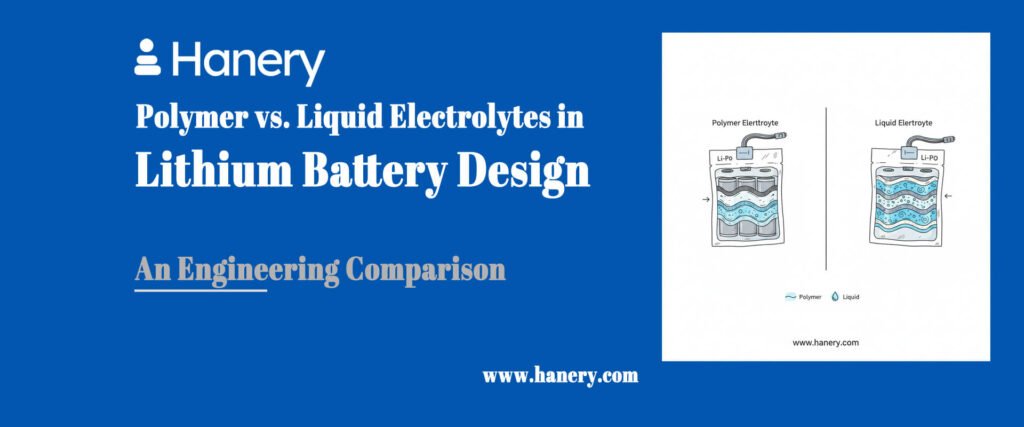
Polymer vs. Liquid Electrolytes in Lithium Battery Design: An Engineering Comparison
In the intricate world of electrochemical energy storage, the spotlight often falls on the active materials—the anode and the cathode. We discuss lithium, cobalt, nickel, and graphite as if they are the sole protagonists of the battery story. However, there is a third, silent partner that dictates the safety, form factor, and ultimate performance of the cell: the Electrolyte.
The electrolyte is the medium of transport, the chemical highway that allows lithium ions (Li+) to shuttle back and forth between electrodes during charge and discharge cycles. For decades, this highway was paved with liquid organic solvents. But as the demand for thinner, safer, and more flexible devices grows, the industry has increasingly turned toward Polymer Electrolytes.
For Original Equipment Manufacturers (OEMs), product designers, and procurement managers, the choice between liquid and polymer electrolytes is a fundamental engineering decision. It affects the manufacturing cost, the device’s physical shape, and its safety profile. A drone requires the lightweight, high-discharge characteristics that polymer architectures facilitate, while a massive grid storage system might prioritize the cost-efficiency of liquid-based cylindrical cells.
At Hanery, we operate at the forefront of this chemical divergence. As a leading Chinese manufacturer specializing in polymer lithium batteries (Li-Po), 18650 packs (Liquid Li-Ion), and Lithium Iron Phosphate (LiFePO4) solutions, we engineer both systems daily. We understand that there is no “perfect” electrolyte—only the right electrolyte for the specific application.
This comprehensive guide delves into the deep science of electrolyte technology. We will compare the structural physics of liquids versus polymers, analyze the conductivity trade-offs, and explore the manufacturing complexities that drive cost. Whether you are designing a flexible wearable or a high-torque power tool, this analysis will provide the technical context needed to make an informed power selection.
Table of Contents
Structural Differences: The Wet vs. The Matrix
The primary distinction between standard Lithium-Ion (Li-Ion) and Lithium-Polymer (Li-Po) batteries lies in the physical state of the electrolyte.
Liquid Electrolytes (The "Wet" System)
In a traditional 18650 or prismatic cell, the electrolyte is a liquid solution.
- Composition: It typically consists of lithium salts—most commonly Lithium Hexafluorophosphate (LiPF6)—dissolved in a mixture of organic solvents such as Ethylene Carbonate (EC), Dimethyl Carbonate (DMC), or Diethyl Carbonate (DEC).
- The Separator: Because the liquid flows freely, a distinct physical barrier is required to keep the anode and cathode from touching (shorting). This is the Separator, usually a microporous film made of Polyethylene (PE) or Polypropylene (PP). The liquid soaks into this separator and the porous electrodes like water in a sponge.
Polymer Electrolytes (The "Matrix" System)
In a Li-Po cell, the electrolyte is not a free-flowing liquid.
- Dry Solid Polymer (SPE): The earliest research focused on pure solid polymers (like Polyethylene Oxide – PEO) where the salt is dissolved directly into the solid plastic. However, these have poor conductivity at room temperature.
- Gel Polymer Electrolytes (GPE): This is what is found in almost all commercial “Li-Po” batteries today, including those manufactured by Hanery. It is a hybrid system. The polymer (such as PVDF-HFP) forms a 3D matrix or “cage” that traps liquid solvent molecules.
- The Structure: It behaves like a semi-solid gel. The polymer acts as both the electrolyte holder and the separator. It bonds the anode and cathode together chemically and physically, eliminating the need for heavy external pressure to maintain contact.
Conductivity Comparison: The Speed of Ions
Conductivity is the measure of how easily ions can move through the medium. In battery terms, higher conductivity generally means lower internal resistance and better high-power performance.
Liquid Superiority
Liquid electrolytes are the champions of conductivity.
- Ionic Mobility: In a low-viscosity liquid, lithium ions can swim freely.
- The Metric: A standard liquid electrolyte at room temperature (25℃) typically exhibits an ionic conductivity of roughly 10⁻² S/cm (Siemens per centimeter).
- Temperature: Liquids maintain decent conductivity even as temperatures drop, although they can thicken. However, specialized low-temp liquid formulas exist that function down to -40℃.
Polymer Challenges
Polymer electrolytes generally suffer from lower ionic conductivity.
- The Matrix Obstacle: In a gel, the ions must navigate through the polymer chains. It is like running through water (Liquid) versus running through mud or gelatin (Polymer).
- The Metric: Gel polymers typically achieve conductivities in the range of 10⁻³ S/cm$ to 10⁻⁴ S/cm.
- Hanery Engineering: To combat this, Hanery engineers utilize specialized plasticizers and high-surface-area electrode structures. While the material conductivity is lower, the thinness of the polymer layer allows us to reduce the total distance the ions must travel, effectively compensating for the lower speed to achieve high C-rates in our performance series.
Safety Performance: Volatility and Containment
Safety is the defining characteristic that drove the adoption of polymer technology in consumer electronics.
The Volatility of Liquids
Liquid organic solvents are inherently volatile and flammable.
- Vapor Pressure: As a liquid cell heats up, the solvents vaporize, creating internal pressure. If the pressure exceeds the limit of the steel can, the safety valve vents. If the vent fails, the can explodes.
- Leakage: If the casing is breached, the liquid can leak out, creating a fire hazard and shorting adjacent electronics.
The Stability of Polymers
Polymer electrolytes offer a significant safety upgrade.
- Non-Volatile: The gel matrix suppresses the vapor pressure of the solvents. Even if the cell gets hot, it is less likely to generate massive gas pressure.
- Chemical Stability: Polymers are less reactive with the electrode materials at high voltages, reducing the risk of electrolyte decomposition.
- Dendrite Suppression: While not immune, the physical barrier of the polymer matrix helps suppress the growth of lithium dendrites (sharp crystals that cause internal shorts) better than a simple liquid/separator setup.
Pouch Flexibility: Liberation from the Can
The most visible difference between the two technologies is the form factor.
Rigid Constraints
Liquid electrolytes require a rigid container.
- Pressure Vessel: Because liquids generate gas and require pressure to maintain electrode contact, they must be housed in steel or thick aluminum cans (Cylindrical or Prismatic).
- Design Limits: This limits device designers. A cylindrical battery leaves “dead space” (interstitial air gaps) when packed into a square device.
Polymer Freedom
Because the polymer electrolyte adheres the anode to the cathode (lamination), no external pressure is needed to keep the stack together.
- The Pouch: This allows Hanery to package the battery in a soft, flexible aluminum-laminate film.
- Custom Shapes: We can manufacture Li-Po batteries that are ultra-thin (0.5mm), curved (for wristbands), or L-shaped (to fit around a smartphone motherboard). This geometric freedom allows OEMs to utilize every cubic millimeter of internal volume in their device.
Manufacturing Complexity: Pouring vs. Curing
The production processes for liquid and polymer batteries diverge significantly, impacting cost and scalability.
Liquid Manufacturing (High Speed)
- Winding: The electrodes are wound into a “jelly roll” and inserted into a can.
- Injection: The liquid electrolyte is injected at high speed.
- Sealing: The can is crimped or laser welded.
- Scale: This process is highly automated and extremely fast, allowing for the massive economies of scale seen in 18650 production.
Polymer Manufacturing (Precision Chemistry)
- Lamination/Stacking: Electrodes are often stacked rather than wound (Z-fold).
- In-Situ Polymerization: In some advanced processes, liquid precursors are injected and then thermally cured to turn into a gel inside the pouch. This “baking” step adds time.
- Environmental Control: Polymer precursors are extremely sensitive to moisture. Hanery’s polymer lines require stricter environmental controls (lower dew point dry rooms) than standard liquid lines, adding to the overhead complexity.
Leakage Resistance: The "Dry" Advantage
Leakage is a catastrophic failure mode for sensitive electronics, particularly in medical and military applications.
Liquid Risks
Despite advanced gaskets and crimping, liquid electrolyte cells can leak over time, especially under thermal cycling or vibration. The corrosive electrolyte can destroy circuit boards instantly.
Polymer Containment
Gel polymers are essentially leak-proof.
- Immobility: Even if the pouch is punctured or cut with scissors, the electrolyte does not flow out. It remains trapped in the polymer matrix.
- Safety in Abuse: This feature makes Li-Po batteries the preferred choice for devices that might undergo physical trauma, such as RC cars or drones. While a puncture is still a fire risk due to the lithium, the lack of spraying conductive liquid prevents the failure from spreading to neighboring components.
Density Limitations: Gravimetric vs. Volumetric
When comparing “Energy Density,” one must specify: Density by Weight (Gravimetric) or Density by Volume (Volumetric)?
Gravimetric Density (Wh/kg)
Winner: Polymer (Li-Po)
- By eliminating the heavy steel can and replacing it with a foil pouch, Li-Po batteries are significantly lighter.
- For applications like aviation (drones/eVTOL) where gravity is the enemy, Li-Po is the only viable option.
Volumetric Density (Wh/L)
Winner: Liquid (Cylindrical)
- In a liquid cell, the active material (anode/cathode) is packed very tightly. The liquid fills 100% of the microscopic voids.
- In a polymer cell, the polymer matrix itself takes up space. That is volume occupied by “inert” glue rather than energy-storing lithium. Therefore, a standard cylindrical cell often holds slightly more energy per cubic centimeter of active core than a polymer cell, although the polymer cell catches up at the pack level by eliminating air gaps.
Cost Analysis: The Price of Performance
For a procurement manager, the decision often comes down to the Bill of Materials (BOM) cost.
The Economy of Scale
- Liquid (18650/21700): These are commodities. Produced in the billions, they offer the lowest cost per Watt-hour ($/Wh). If your device has space for a standard cylinder, it is always the cheaper option.
- Polymer (Pouch): These are often semi-custom. The manufacturing process is slower (due to curing/stacking), and the materials (laminate foil, polymer salts) are more expensive.
- The Hanery Value: While Li-Po is more expensive per cell, it can lower total system cost by eliminating the need for battery holders, simplifying the housing design (making the device smaller), and reducing weight-related shipping costs.
Current Research: The Bridge to Solid State
The distinction between liquid and polymer is becoming blurred by advanced research.
Semi-Solid and Solid State
The industry is moving toward Solid-State Batteries (SSB).
- The Evolution: Current Gel Polymers are the bridge. Future “Solid Polymer” electrolytes aim to remove the liquid plasticizer entirely.
- Composite Electrolytes: Hanery R&D is investigating composite electrolytes that mix ceramic particles (high conductivity) into a polymer binder (flexibility). This aims to achieve the high conductivity of liquids with the safety and structure of polymers.
- High Voltage: Polymers are also being engineered to withstand higher voltages (up to 4.5V or 5.0V), which liquid electrolytes typically cannot handle without decomposing.
Application Requirements: Choosing the Right Chemistry
So, which one should you choose for your project?
Choose Liquid (18650/21700) If:
- Cost is the primary driver.
- The device has ample internal space or is already tube-shaped (Flashlights, Vaping devices).
- The device has a rigid chassis (Power tools, Electric Vehicles).
- Standardization and replaceability are required.
Choose Polymer (Li-Po) If:
- Thinness is critical (Tablets, Smartphones < 8mm thick).
- Weight is the primary constraint (Drones, Handhelds).
- Shape is irregular (Wearables, Smart Rings, Medical patches).
- High Discharge Burst is needed (Jump starters, Racing drones).
Comparison Chart: Liquid vs. Gel Polymer Electrolyte
| Feature | Liquid Electrolyte (Li-Ion) | Gel Polymer Electrolyte (Li-Po) |
| Physical State | Free-flowing liquid solution | Semi-solid / Gel matrix |
| Container | Rigid Steel/Aluminum Can | Flexible Aluminum Foil Pouch |
| Ionic Conductivity | High (10⁻² S/cm) | Moderate (10⁻³ S/cm) |
| Safety | Volatile, leak risk, vent pressure | Stable, no leak, swells on failure |
| Weight | Heavy (Steel casing) | Light (Foil packaging) |
| Shape Factor | Cylindrical / Prismatic (Fixed) | Custom (Thin, Curved, L-shape) |
| Manufacturing Cost | Low (High automation) | Moderate/High (Complex process) |
| Cycle Life | High (500 – 1000+) | Moderate (300 – 800) |
| Primary Use | EVs, Power Tools, Laptops | Phones, Drones, Wearables |
Frequently Asked Questions
Is “Li-Po” completely dry?
No. Almost all commercial Li-Po batteries are “Gel Polymers.” They contain a liquid solvent trapped in a polymer plastic. True “Dry” solid polymer batteries are rare and mostly still in research or specialized high-temp applications.
Why do Li-Po batteries puff or swell?
Swelling is caused by the generation of gas. While the polymer matrix suppresses gas, abuse (overcharging/overheating) causes the electrolyte to decompose. Because the pouch is flexible, it expands like a balloon. A rigid liquid cell would trigger a safety valve or explode under the same pressure.
Which electrolyte is better for cold weather?
Generally, liquid electrolytes perform better in the cold. Polymers tend to stiffen (glass transition), which drastically increases resistance. However, Hanery offers “Low-Temp” polymer formulations with specialized solvents to mitigate this.
Can I replace a Li-Ion battery with a Li-Po battery?
Electrically, yes, if the voltage (3.7V nominal) is the same. Physically, you must ensure the Li-Po is protected. Li-Po cells are soft and vulnerable to puncture; they cannot be exposed like a hard 18650 cell.
Are polymer electrolytes flammable?
Yes. While less volatile than free liquids, the polymer matrix and the trapped solvents are organic and can burn if the battery goes into thermal runaway. They are safer, but not fireproof.
Do polymer batteries have memory effect?
No. Neither Liquid Li-Ion nor Polymer Li-Po batteries suffer from memory effect. You can charge them at any state of discharge.
Why are Li-Po batteries used in drones?
Drones need two things: low weight and massive power bursts (C-rate). The laminated structure of Li-Po cells allows for very low internal resistance and the pouch saves weight, making them superior to cylindrical cells for flight.
What is the shelf life difference?
Both chemistries have similar shelf lives (2-3 years) if stored at storage voltage (3.8V). However, Li-Po cells are slightly more susceptible to moisture ingress through the pouch seals over very long periods (5+ years).
Can Hanery customize the electrolyte for my application?
Yes. We can adjust the additive blend in the electrolyte. For example, we can add flame retardants for safety or vinylene carbonate (VC) to extend cycle life, depending on whether you need a safe battery or a long-lasting one.
Is Solid State the same as Polymer?
Solid State is the evolution of Polymer. While current Li-Po uses a gel (liquid + polymer), Solid State uses a solid (ceramic or dry polymer) with zero liquid. Solid State is the future goal for maximum safety and density.
Summary & Key Takeaways
The choice between Polymer and Liquid electrolytes is a choice between flexibility and standardization. Liquid electrolytes represent the mature, cost-effective workhorse of the energy industry—unbeatable for powering cars and tools. Polymer electrolytes represent the adaptable, lightweight future—essential for the devices we wear, carry, and fly.
- Structure: Liquid is a wet sponge; Polymer is a hydrated gel.
- Performance: Liquid wins on raw conductivity and cost; Polymer wins on weight, shape, and safety.
- Design: If you need to fit a battery into a unique, thin, or curved space, Polymer is the only option.
- The Future: Both technologies are evolving, with Polymer serving as the technological bridge to the holy grail of Solid-State batteries.
At Hanery, we do not favor one over the other; we favor the solution that fits the problem. Our dual manufacturing capabilities allow us to offer unbiased advice and high-quality products regardless of the chemistry. Whether you need the robust reliability of an 18650 pack or the custom geometry of a soft-pack Li-Po, Hanery engineering ensures your innovation is powered by the best science available.
Engineer Your Perfect Power Source
Are you torn between the cost of cylindrical cells and the flexibility of polymer pouches? Do you need a custom battery design that defies standard shapes?
Contact Hanery Engineering Team Today. Reach out for a consultation on electrolyte selection and custom pack design. Let us help you balance cost, performance, and form factor for your next breakthrough product.
Factory-Direct Pricing, Global Delivery
Get competitive rates on high-performance lithium batteries with comprehensive warehousing and logistics support tailored for your business.
Contact Info
- info@hanery.com
- +86 13414472012
- https://www.hanery.com/
- A15 Building, No.6 Xinfeng Road, Longcheng Street, Longgang District, Shenzhen, China