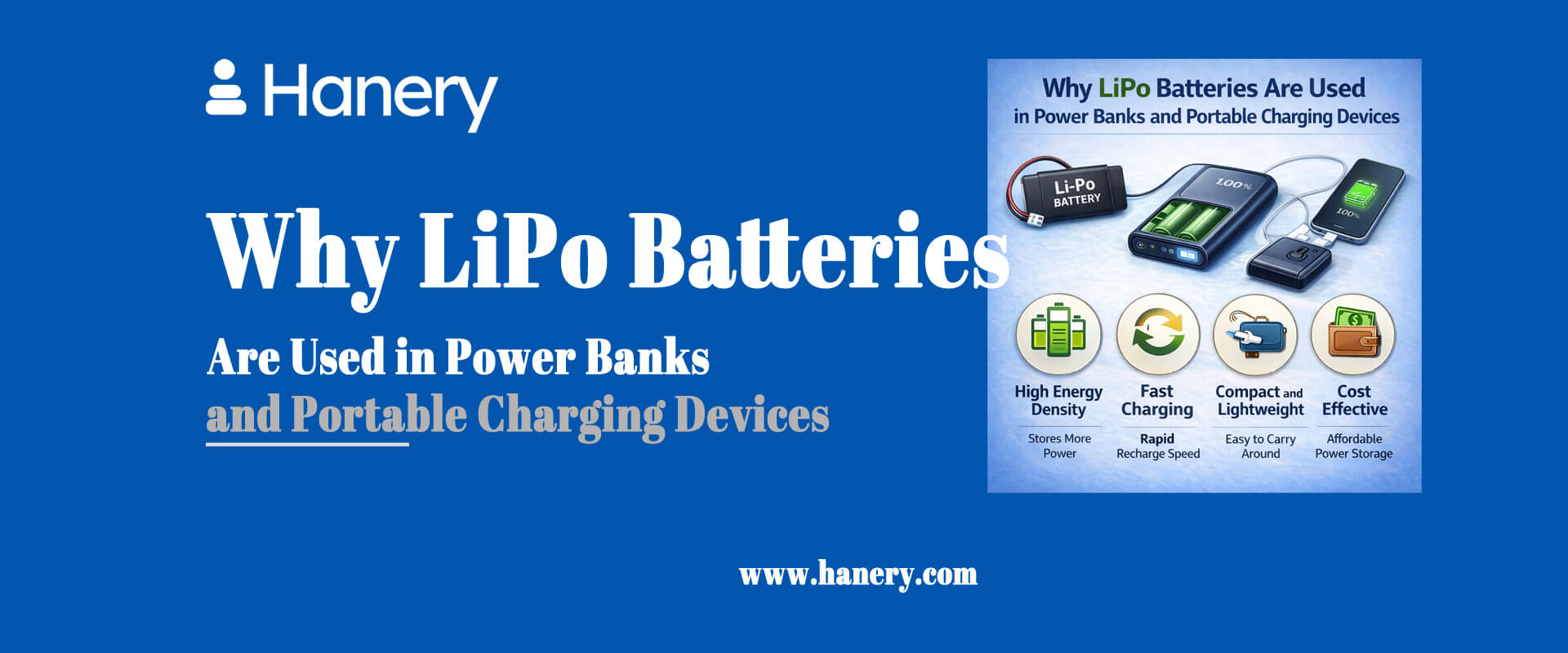



Why LiPo Batteries Are Used in Power Banks and Portable Charging Devices
In the era of the modern digital nomad, the power bank has evolved from a bulky accessory into an essential survival tool. Whether charging a laptop on a trans-Atlantic flight or keeping a smartphone alive during a remote trek, the demand for portable energy is insatiable. But beneath the sleek casings of these devices lies a critical engineering choice: the battery chemistry. While cylindrical 18650 lithium-ion cells once ruled the market, Lithium Polymer (LiPo) batteries have become the gold standard for premium, ultra-portable power banks.
At Hanery, we are at the forefront of this shift. As a dedicated Chinese manufacturer specializing in polymer lithium batteries, 18650 packs, and Lithium Iron Phosphate (LiFePO4) solutions, we engineer the power sources that drive the world’s most innovative consumer electronics. We understand that for Original Equipment Manufacturers (OEMs), the choice of battery dictates the form factor, safety profile, and user experience of the final product.
This article delves into the technical and practical reasons why LiPo technology is the preferred engine for modern power banks. We will explore the physics of size efficiency, the safety advantages of gel electrolytes, and the high-discharge capabilities that make fast charging possible.
Table of Contents
Size Efficiency: The "Dead Space" Problem
The primary driver for LiPo adoption in power banks is geometric freedom. Traditional 18650 lithium-ion cells are rigid steel cylinders, typically 18mm in diameter and 65mm in length. When these cylinders are packed together to form a battery, they create inevitable gaps between them—referred to in the industry as “dead space.”
The Rectangular Advantage
LiPo batteries utilize a pouch format. They are manufactured by stacking layers of anode and cathode material rather than winding them into a canister.
- Space Utilization: LiPo cells are rectangular and flat. They can be stacked perfectly flush against each other, achieving a packing efficiency of nearly 95-98%.
- Slim Profiles: Hanery can manufacture LiPo cells as thin as 2mm, allowing for power banks that can slide into a wallet or attach magnetically to the back of a phone without adding bulk.
High Capacity in Small Volume
Energy density—the amount of energy stored per unit of volume—is the holy grail of portable electronics. LiPo technology excels in Volumetric Energy Density (Wh/L).
Eliminating the Steel Can
A significant portion of an 18650 cell’s weight and volume is the steel casing, which contributes nothing to energy storage. LiPo batteries use a lightweight aluminum-polymer laminate film as an enclosure. By removing this heavy structural waste, LiPo cells can dedicate more internal volume to active chemical materials.
- The Result: A LiPo power bank can often be 20% lighter and 30% smaller than a cylindrical cell power bank of the exact same capacity (mAh). For consumers carrying devices in pockets or purses, this density is a key selling point.
Charging Cycle Expectations
A common question from our OEM clients concerns longevity. How many times can a LiPo power bank be recharged?
The 500-Cycle Benchmark
Standard consumer-grade LiPo batteries generally offer 300 to 500 complete charge/discharge cycles before their capacity drops to 80% of the original rating. While some high-quality cylindrical cells can achieve 800+ cycles, the trade-off in size and weight often makes LiPo the superior choice for consumer electronics where product lifecycles are typically 2-3 years.
Hanery’s Optimization:
At Hanery, we utilize advanced electrolyte additives and high-purity cathode materials to push LiPo cycle life closer to the 800-cycle mark, bridging the gap between ultra-portability and long-term durability.
Safety for Consumer Handling
Safety is paramount when designing a device that users will carry in pockets or sleep next to. LiPo batteries offer distinct safety advantages due to their electrolyte composition.
Liquid vs. Gel Electrolyte
- Li-ion Cylinders: Typically use a liquid electrolyte. If the steel casing is pierced, this liquid can leak, creating a toxic hazard and potential fire risk.
- LiPo Pouches: Use a polymer gel or semi-solid electrolyte. This gel is far less likely to leak, even if the pouch is punctured.
Failure Modes
In the event of a catastrophic failure (such as overcharging or internal short circuit), cylindrical cells can build up immense pressure inside their metal cans, potentially leading to an explosion if the safety vent fails. LiPo batteries, being soft pouches, will swell or “puff” first. While a swollen battery is dangerous and should be disposed of, this visual warning is generally safer than the instantaneous rupture of a metal canister.
Fast Output Capability (C-Rate)
Modern smartphones, tablets, and laptops demand more power than ever. Technologies like USB-C Power Delivery (PD) and Qualcomm Quick Charge require the power bank to deliver high currents (Amps) instantly.
Low Internal Resistance
LiPo batteries generally feature lower internal resistance compared to standard energy cells. This allows them to support higher C-Rates (discharge rates).
- Performance: A high-quality Hanery LiPo cell can discharge at rates of 5C to 10C or higher without significant voltage sag. This capability ensures that a power bank can charge a laptop at 65W or 100W without overheating or throttling power delivery.
Thermal Performance
Heat is the enemy of battery longevity and performance. The physical shape of LiPo batteries gives them a thermodynamic edge.
Surface Area to Volume Ratio
A flat, rectangular LiPo cell has a massive surface area relative to its volume.
- Dissipation: Heat generated during fast charging can escape quickly through the large flat surfaces of the pouch.
- Comparison: Cylindrical cells trap heat in their core, which must travel through layers of rolled material to reach the surface.
- Benefit: Cooler operation means safer fast charging and less degradation of the internal chemistry over time.
OEM Design Requirements
For Original Equipment Manufacturers (OEMs), the ability to customize the power source is critical for product differentiation.
Customization Freedom
- Shape: Unlike 18650s, which come in one fixed size (18mm x 65mm), LiPo batteries can be manufactured in virtually any dimension. Hanery can produce L-shaped batteries, ultra-thin strips, or curved cells to fit unique device housings.
- Tooling Costs: Creating custom molds for LiPo cells is significantly cheaper and faster than retooling for new cylindrical metal cans. This allows startups and major brands alike to prototype unique power bank designs rapidly.
Cost Considerations
Historically, LiPo batteries were significantly more expensive than cylindrical cells. However, the gap is closing.
- Manufacturing Complexity: LiPo manufacturing involves stacking and folding, which can be more complex than winding cylindrical cells. However, automation at facilities like Hanery’s has driven costs down.
- Total Product Cost: While the raw cell might cost slightly more, the elimination of heavy internal brackets (needed to hold 18650s) and the ability to use thinner plastic casings (due to lower weight) often makes the total bill of materials for a premium LiPo power bank competitive.
Port Compatibility
The battery must match the ports. The rise of USB-C has fundamentally changed power bank architecture.
The High-Voltage Requirement
To support USB-C PD outputs of 20V (for laptops), power banks often arrange cells in Series (e.g., 3S or 4S configurations to reach 11.1V or 14.8V).
- LiPo Flexibility: Creating a multi-cell series pack with LiPo is often simpler structurally than welding together a brick of cylindrical cells. The flat tabs of LiPo cells allow for robust, low-resistance connections that handle the high currents of modern ports efficiently.
Emerging Trends: The Future of Portable Power
The power bank market is not stagnant. Hanery is actively R&D’ing the next generation of energy storage solutions.
- Graphene-Enhanced LiPo: By adding graphene to the electrodes, we can reduce internal resistance even further, enabling ultra-fast recharging of the power bank itself (e.g., 0-100% in 15 minutes).
- Solid-State Batteries: The future lies in replacing the gel electrolyte with a solid material, making the battery virtually non-flammable and significantly more energy-dense.
- Sustainable Materials: As global regulations tighten, the shift toward cobalt-free chemistries and easier-to-recycle pouch designs is accelerating.
Frequently Asked Questions
Are LiPo power banks allowed on airplanes?
Yes, but with restrictions. Generally, power banks under 100 Watt-hours (Wh) are allowed in carry-on bags without approval. Those between 100Wh and 160Wh usually require airline approval. They are strictly prohibited in checked luggage due to fire risk.
Why do LiPo power banks swell?
Swelling is caused by the generation of gas (electrolyte decomposition) inside the sealed pouch. This usually happens due to overheating, overcharging, or simply old age. If your power bank is swollen, stop using it immediately and dispose of it at a recycling center.
Which lasts longer: Li-ion (18650) or LiPo?
Typically, high-quality cylindrical Li-ion cells (like those from Panasonic or LG) have a longer cycle life (500-1000 cycles) than average LiPo cells (300-500 cycles). However, LiPo is chosen for form factor and weight, not necessarily for maximum cycle life.
Can I leave my LiPo power bank plugged in all the time?
It is not recommended. While modern BMS (Battery Management Systems) prevent overcharging, keeping a LiPo battery at 100% voltage constantly causes stress on the chemistry, leading to faster degradation and swelling.
What is the best way to store a LiPo power bank if I’m not using it?
Store it at roughly 50% charge in a cool, dry place. Storing it fully empty can kill the battery (due to self-discharge), and storing it fully charged degrades capacity.
Do LiPo batteries have a memory effect?
No. Unlike older Nickel-Cadmium (NiCd) batteries, LiPo and Li-ion batteries do not have a memory effect. You do not need to fully discharge them before recharging. In fact, shallow discharges are better for their lifespan.
Why are some power banks heavy and some light for the same capacity?
Heavy ones likely use steel-cased 18650 cylindrical cells. Lighter ones use aluminum-pouch LiPo cells. A 10,000mAh LiPo bank is noticeably slimmer and lighter than a 10,000mAh cylindrical bank.
Is fast charging bad for LiPo power banks?
Fast charging generates heat. While modern LiPo cells are designed to handle it, consistent exposure to high heat will degrade the battery faster than slow charging. However, the convenience usually outweighs the minor loss in total lifespan.
Can Hanery customize a power bank battery for my specific device?
Yes. Hanery specializes in OEM/ODM services. We can design a custom-shaped LiPo cell to fit perfectly inside your unique device housing, maximizing capacity and minimizing wasted space.
What certifications do LiPo power banks need?
To be sold globally, they typically need UN38.3 (for shipping), UL 2056 (specifically for power banks), CE, FCC, and RoHS compliance. Hanery assists partners in obtaining these certifications.
Summary & Key Takeaways
The dominance of Lithium Polymer batteries in the power bank industry is not a trend; it is an engineering necessity driven by consumer demand for thinner, lighter, and faster-charging devices.
- Form Factor is King: Only LiPo technology allows for the ultra-slim profiles required by modern aesthetics.
- Performance: High discharge rates enable the fast-charging protocols (PD, QC) that users rely on.
- Safety: Gel electrolytes and soft-pouch designs offer a safer failure mode than pressurized metal cans.
- Customization: Hanery’s ability to shape batteries to any dimension empowers OEMs to innovate without constraint.
At Hanery, we are committed to pushing the boundaries of what portable power can achieve. Whether you are an OEM looking to design the next market-leading power bank or a business seeking reliable custom battery packs, our engineering expertise and manufacturing capability are at your service.
Ready to Power Your Innovation?
Don’t let standard battery sizes limit your product design. Partner with a manufacturer that understands the art of custom power.
Reach out for a consultation on your custom battery needs, from rapid prototyping to mass production and global certification. Let’s build the future of portable power together.
Change log:
25/01/2026 Article posted.
27/03/2026 Added Related Artciles.
Factory-Direct Pricing, Global Delivery
Get competitive rates on high-performance lithium batteries with comprehensive warehousing and logistics support tailored for your business.
Contact Info
- [email protected]
- +86 13414472012
- https://www.hanery.com/
- A15 Building, No.6 Xinfeng Road, Longcheng Street, Longgang District, Shenzhen, China
You May Like: