

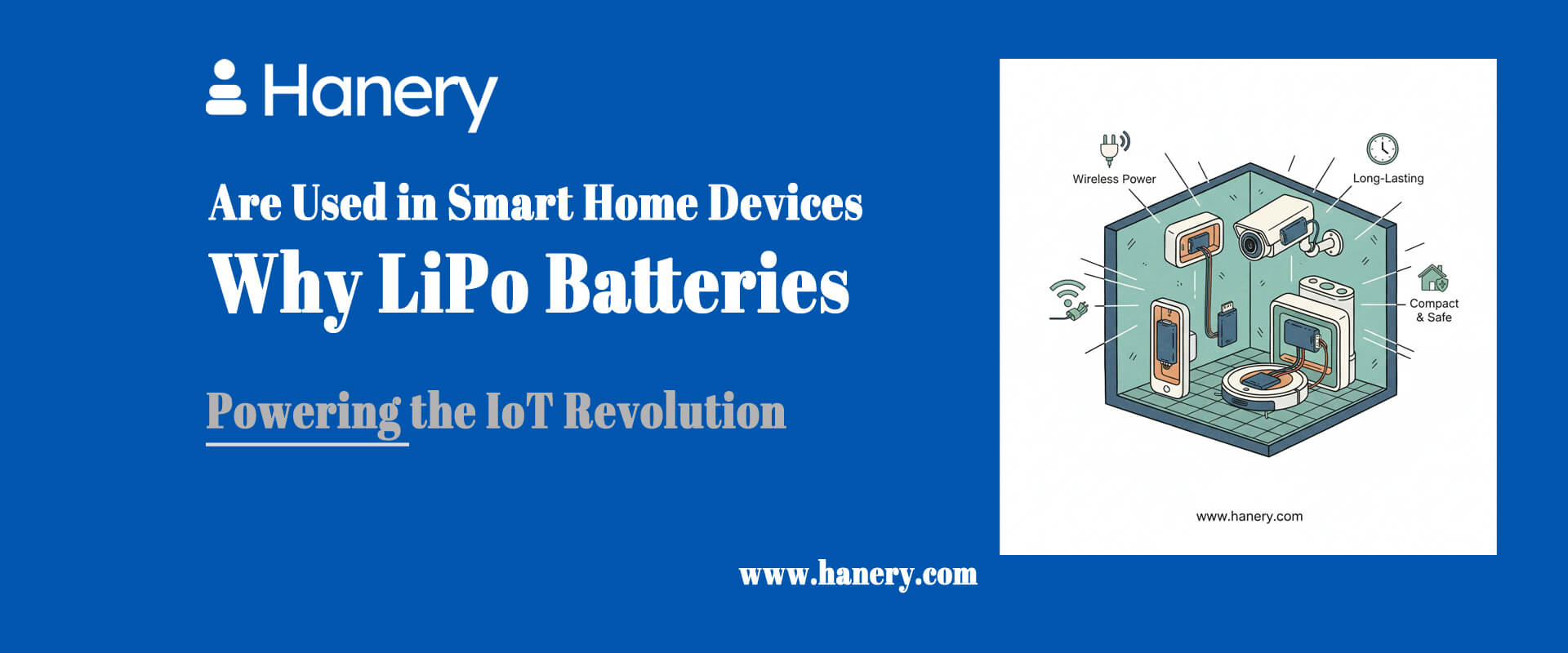

Why LiPo Batteries Are Used in Smart Home Devices
The concept of the “home” has fundamentally changed. It is no longer just a physical shelter composed of bricks and mortar; it is a digital organism. The modern home breathes through air quality sensors, sees through video doorbells, and secures itself with biometric locks. This transition to the “Smart Home” or the Internet of Things (IoT) has created a massive demand for reliable, compact, and efficient energy storage. While the devices themselves—the smart thermostats, the automated blinds, the security cameras—garner the headlines, the unsung hero enabling their existence is the Lithium Polymer (LiPo) battery.
For Original Equipment Manufacturers (OEMs) and product designers, the choice of power source is the single most critical decision in the development phase. A smart lock that dies in a month is not “smart”; it is a liability. A security camera that fails during a power outage is useless. The industry has largely standardized on LiPo technology because it offers a unique combination of energy density, geometric flexibility, and chemical stability that legacy batteries (like Alkaline or NiMH) simply cannot match.
At Hanery, we are the engineers behind this silent revolution. As a premier Chinese manufacturer specializing in polymer lithium batteries, 18650 packs, and Lithium Iron Phosphate (LiFePO4) solutions, we work side-by-side with global smart home brands. We customize the power systems that ensure your lights turn on when you walk in the room and your door unlocks when you approach. We understand that in the smart home, the battery is the user experience.
This comprehensive guide explores the ten critical reasons why LiPo batteries are the dominant choice for home automation. From standby power efficiency to the future of wireless charging, we will dissect the engineering that keeps the connected home online. While these low-drain systems are designed for long-term standby, they are still governed by the laws of calendar aging. Read our engineering analysis on the typical lifespan of lithium polymer batteries explained to optimize your hardware deployment.
Table of Contents
Standby Power Efficiency: The Sleep Mode Challenge
The defining characteristic of a smart home device is that it spends 99% of its life doing nothing. A window sensor might only transmit data once a day. A smart lock motor only runs for three seconds when you enter. The rest of the time, the device sits in “Sleep Mode,” waiting for a wake-up signal.
The Self-Discharge Battle
For battery engineers, “doing nothing” is often harder than working.
- Legacy Issues: Traditional Nickel-Metal Hydride (NiMH) batteries suffer from high self-discharge rates. A NiMH battery sitting in a sensor might lose 20-30% of its charge in a month just by existing. This means the user has to change batteries constantly, even if the device is rarely used.
- The LiPo Advantage: High-quality LiPo batteries manufactured by Hanery have an extremely low self-discharge rate—typically less than 2-3% per month. This allows smart devices to remain installed for months or even a year on a single charge.
Handling Pulse Loads
While the device sleeps, it still needs to listen for a “Wake Up” signal (via Zigbee, Z-Wave, or Wi-Fi). When it wakes, it often requires an immediate, high-current pulse to fire a radio signal or turn a motor.
- Internal Resistance: LiPo batteries have very low internal resistance. This means they can sit idle for weeks and then instantly deliver a 2-Amp pulse to a smart lock motor without a significant voltage drop. Alkaline batteries often struggle with these “pulse loads,” causing the device to reset or fail to unlock.
Compact Form Factor: Designing for Aesthetics
In the smart home market, aesthetics are king. Consumers do not want bulky industrial boxes on their walls; they want sleek, unobtrusive sensors and elegant hardware that blends into their décor. This design requirement creates a “Geometric Constraint” that only LiPo can solve.
Escaping the Cylinder
Legacy batteries (AA, AAA, 18650) are rigid steel cylinders. They dictate the shape of the device. If you use AA batteries, your device must be at least as thick as a AA battery plus the plastic housing.
- Pouch Flexibility: LiPo batteries use a flexible aluminum laminate pouch. They are not limited to cylinders. Hanery manufactures LiPo cells that are:
- Ultra-Thin: As thin as 1mm or 2mm for window sensors that must slide between frames.
- Custom Shapes: L-shaped or curved batteries to fit into the handles of smart door locks or the round casing of a smart thermostat.
Maximizing Volume
By eliminating the “dead air space” found between cylindrical cells, LiPo batteries allow designers to utilize almost 100% of the internal volume of a device enclosure. For a slim video doorbell, this efficient use of space allows for a 5000mAh battery in a housing that would only fit 2000mAh worth of cylindrical cells.
High Safety Standards: Powering the Living Space
Safety is non-negotiable when a product is installed inside a home. A battery failure in a garage tool is dangerous; a battery failure in a smoke detector or a baby monitor in a nursery is catastrophic.
The Gel Electrolyte Advantage
Standard lithium-ion cells often use liquid electrolytes which, if leaked, are flammable and toxic. LiPo batteries typically utilize a gel polymer electrolyte.
- Leak Resistance: This gel is semi-solid and bonded to the polymer matrix. Even if the device is dropped or the battery pouch is punctured, the electrolyte does not flow freely like a liquid. This significantly reduces the risk of fire or chemical damage to the home.
Hanery’s Safety Architecture
For smart home applications, Hanery integrates redundant safety systems:
- Smart BMS: Every pack includes a Battery Management System that monitors voltage and temperature 24/7.
- Ceramic Separators: We use high-grade separators that resist melting even at high temperatures.
- Certification: Our smart home batteries are certified to UL 1642 and IEC 62133 standards, ensuring they meet the strict fire safety codes required for household appliances in the US and EU markets.
Low Heat Systems: Protecting Sensitive Electronics
Smart home devices are often packed with sensitive microprocessors, Wi-Fi radios, and image sensors. They are also frequently enclosed in plastic housings with little to no airflow (e.g., inside a wall switch).
The Thermal Threat
Heat kills electronics. If a battery generates significant heat during discharge (charging a phone) or operation (powering a speaker), it can degrade the device’s processor or warp the plastic casing.
Efficient Energy Transfer
LiPo batteries operate with high efficiency. Because of their low internal resistance, very little energy is wasted as heat during the discharge cycle (I²R losses are minimal).
- Cool Running: A Hanery LiPo battery powering a smart display stays cool to the touch. This allows the device to operate reliably without heavy heatsinks or cooling fans, which would add noise and bulk to the product.
Long-Term Daily Cycle Life
Some smart home devices are “Install and Forget,” but others are “High Traffic.” A portable smart speaker or a robotic vacuum cleaner might be charged and discharged daily.
Durability Over Time
While consumer electronics typically aim for 300-500 cycles (2 years), smart home appliances are expected to last 5-10 years.
- Cycle Life Optimization: For these applications, Hanery adjusts the electrode chemistry. By slightly reducing the energy density (making the cathode less “aggressive”), we can extend the cycle life to 800 or 1,000 cycles.
- The “Plateau”: Even after years of use, high-quality LiPo cells maintain a usable capacity. A robotic vacuum might run for 90 minutes when new and still run for 70 minutes after 3 years, which is acceptable degradation for the user.
IoT Compatibility: Stable Voltage for Connectivity
The “Internet of Things” relies on connectivity. Whether it is Wi-Fi, Bluetooth Low Energy (BLE), Zigbee, or Thread/Matter, these radios require stable voltage to maintain a connection.
The Brownout Risk
If a battery’s voltage sags under load (e.g., when the motor turns on), the voltage might drop below the minimum required for the Wi-Fi chip (usually 3.3V). This causes the device to disconnect from the network.
- Connection Dropouts: A smart lock that disconnects right when you try to unlock it remotely is a failed product.
The LiPo Solution
LiPo batteries possess a very flat discharge curve. They maintain a steady voltage (approx 3.7V) for the vast majority of their capacity. Even when a sudden load is applied, the voltage remains high enough to keep the radio chips powered and connected. This ensures that your smart home is responsive, not buffering.
Wireless Charging Support
The future of smart home power is wire-free. Users do not want to take their video doorbell off the wall to plug it in; they want it to charge via solar trickle or inductive charging.
The Qi Synergy
LiPo batteries are uniquely suited for wireless (Qi) charging integration.
- Thin Profile: Wireless charging coils are flat. A flat LiPo battery can be stacked directly behind the coil without creating a thick, bulky device.
- Thermal Management: Wireless charging generates heat. The large surface area of a LiPo pouch cell helps dissipate this heat more effectively than a cluster of cylindrical cells, preventing the battery from overheating during the wireless charge cycle.
Consumer Expectations: The Shift to Rechargeable
There has been a massive shift in consumer sentiment regarding disposable batteries. Ten years ago, it was acceptable for a TV remote to use AA batteries. Today, buying a $200 smart thermostat that requires changing alkaline batteries feels antiquated and cheap.
The Premium Experience
Consumers equate “Rechargeable” with “Premium.”
- Eco-Conscious: Modern homeowners are environmentally aware. They prefer a device with a built-in LiPo battery over one that generates landfill waste with disposable alkalines.
- Convenience: Users prefer to plug a device in (or swap a rechargeable pack) rather than run to the store to buy AA batteries. By integrating Hanery LiPo packs, OEMs align their products with these modern consumer values, justifying a higher price point.
Use Cases: Where LiPo Shines
To understand the versatility of LiPo technology, we can look at three distinct smart home categories where Hanery batteries are deployed.
A. Smart Locks (High Power)
- The Challenge: A smart lock needs to physically move a deadbolt. This requires a high-torque motor that draws a massive current spike (burst).
- The LiPo Fix: High-discharge LiPo cells provide the “punch” needed to overcome friction and lock/unlock the door instantly, even if the door is slightly jammed.
B. Window/Door Sensors (Long Life)
- The Challenge: These devices are tiny and must run for a year without maintenance.
- The LiPo Fix: Ultra-small, custom-shaped LiPo cells fit into the slim sensor casing and utilize low-leakage chemistry to survive months of standby.
C. Smart Displays / Thermostats (High Capacity)
- The Challenge: These have bright LCD or OLED screens that consume constant power.
- The LiPo Fix: High-capacity prismatic LiPo cells (similar to tablet batteries) provide the 3000-5000mAh needed to keep the screen bright and responsive throughout the day.
Future Home Automation Trends
As the smart home evolves, so too must the battery. Hanery is actively researching the next generation of power.
- Energy Harvesting: Devices that charge themselves via indoor light (solar) or radio waves (RF harvesting). This requires LiPo batteries with specialized chemistry that can accept extremely low-current “trickle” charges efficiently.
- Matter Protocol: The new universal smart home standard (Matter) will increase device interoperability, likely leading to more devices communicating more often. This will increase the power budget, driving demand for higher energy density batteries (Silicon Anode LiPo).
Comparison Table: Power Sources for Smart Home Devices
| Feature | LiPo (Lithium Polymer) | Alkaline (AA/AAA) | NiMH Rechargeable | Coin Cell (CR2032) |
|---|---|---|---|---|
| Rechargeable | Yes | No | Yes | No |
| Energy Density | High | Low | Moderate | Low |
| Form Factor | Custom / Flexible | Rigid Cylinder | Rigid Cylinder | Rigid Disc |
| Pulse Power | Excellent | Poor | Good | Very Poor |
| Self-Discharge | Low (<3%/mo) | Low | High (>20%/mo) | Very Low |
| Best For | Premium, High-Drain | Low Cost, Low Drain | Budget Rechargeable | Tiny Sensors |
Frequently Asked Questions
Are LiPo batteries safe to leave plugged in all the time?
Yes, if the device has a proper Battery Management System (BMS). Modern smart devices stop charging once the battery is full and switch to “mains power,” bypassing the battery. However, keeping a battery at 100% continuously can degrade its capacity over years.
Why do some smart locks still use AA batteries?
Cost and retrofit ease. AA batteries are cheap and easy for users to understand. However, premium smart locks are moving to rechargeable LiPo packs to offer better motor performance and eliminate the waste of disposable batteries.
Can I replace the LiPo battery in my smart device?
It depends on the design. Some devices have “swappable” packs (like Ring doorbells). Others have embedded batteries. Hanery encourages OEMs to design for repairability, but embedded batteries allow for smaller, more waterproof designs.
How long does a LiPo battery last in a smart sensor?
In a low-power sensor (like a window contact), a properly sized LiPo battery can last 6 to 12 months on a single charge, depending on how often the sensor is triggered.
What happens if the power goes out?
This is the primary benefit of battery-powered smart devices. They continue to operate. A battery-powered smart security camera will continue to record even if the house power is cut, providing security when it is needed most.
Do LiPo batteries work in outdoor smart cameras?
Yes, but temperature is a factor. Standard LiPo batteries work well down to freezing (0°C). For outdoor cameras in cold climates, Hanery manufactures “Low-Temperature” LiPo cells that function down to -20°C or -30°C.
Why is my smart device getting hot while charging?
Some heat is normal. However, excessive heat usually indicates inefficient power conversion or a cheap charging circuit. LiPo batteries themselves should not get painfully hot. If a device is too hot to touch, unplug it.
Can Hanery customize a battery for a weirdly shaped device?
Absolutely. This is our specialty. We can produce batteries in “D” shapes, arches, or ultra-thin strips to fit into the unique industrial designs of modern IoT hardware.
What is the environmental impact of LiPo batteries in smart homes?
While they require mining (lithium/cobalt), they are far better than disposable alkaline batteries because one LiPo prevents the disposal of hundreds of alkaline cells over the device’s life. Recycling programs also recover valuable metals from old LiPo packs.
Does fast charging shorten the life of smart home batteries?
Generally, yes. Slower charging generates less heat and stress. Since smart home devices usually charge overnight or over many hours, there is rarely a need for aggressive fast charging, which helps preserve the battery lifespan.
Summary & Key Takeaways
The smart home is only as smart as its power source. As our homes become more connected, the demand for energy storage that is invisible, reliable, and safe continues to grow. Lithium Polymer batteries have emerged as the definitive solution for this industry, enabling a new generation of devices that are smaller, sleeker, and more powerful than ever before.
- Design Freedom: LiPo’s flexible form factor allows OEMs to build devices that prioritize aesthetics and ergonomics, not battery shape.
- Reliability: Low self-discharge and stable voltage ensure that security sensors and locks work when they are needed most.
- Sustainability: The shift to rechargeable LiPo systems aligns with consumer demand for eco-friendly products and reduces electronic waste.
- Future-Ready: From wireless charging to AI-driven energy management, LiPo technology is evolving to meet the demands of the Matter-connected home.
At Hanery, we are proud to be the silent partner in millions of smart homes around the world. Our commitment to quality, safety, and innovation ensures that when you install a Hanery-powered device, you are installing peace of mind. As the IoT landscape expands, we stand ready to energize the future of living.
Power Your Next Smart Invention
Are you an OEM designing the next breakthrough in home automation? Don’t let standard batteries limit your vision.
Reach out for a consultation on custom battery shapes, low-power standby solutions, and IoT-optimized power systems. Let us help you bring your smart home product to life.
Change log:
06/02/2026 Article posted.
29/04/2026 Added related artciles.
Factory-Direct Pricing, Global Delivery
Get competitive rates on high-performance lithium batteries with comprehensive warehousing and logistics support tailored for your business.
Contact Info
- [email protected]
- +86 13414472012
- https://www.hanery.com/
- A15 Building, No.6 Xinfeng Road, Longcheng Street, Longgang District, Shenzhen, China