

The Future of Lithium Polymer Batteries: Technology Outlook 2030
- Nat
- News and Market
Technical Review by: Hanery Battery Engineering Team | May 2026
The battery industry is currently standing at the precipice of a material science revolution. For the past decade, the Lithium Polymer (LiPo) battery has been the silent workhorse of the digital age, enabling the slim profiles of smartphones, the agility of drones, and the portability of modern medical devices. However, the demands of the next decade—driven by the Internet of Things (IoT), electric aviation, and wearable technology—are outpacing the capabilities of current intercalation chemistry. The era of incremental improvement is ending; the era of radical reinvention has begun.
By 2030, the battery landscape will look fundamentally different. We are moving from liquid electrolytes to solids, from graphite anodes to silicon, and from reactive management to AI-driven predictive control. For Original Equipment Manufacturers (OEMs) and product designers, understanding this roadmap is not just academic—it is a strategic necessity. The devices you are designing today must be ready for the power sources of tomorrow.
At Hanery, we are not just observers of this future; we are active architects of it. As a leading Chinese manufacturer specializing in polymer lithium batteries, 18650 packs, and Lithium Iron Phosphate (LiFePO4) solutions, our R&D laboratories are already stress-testing the chemistries that will dominate the 2030 market. We understand that the future of energy is lighter, safer, and infinitely more intelligent.
This comprehensive technology outlook explores the ten pillars that will define the next generation of LiPo batteries. From the elusive 500 Wh/kg energy density target to the integration of “digital twins” in battery management, this guide provides the technical foresight needed to navigate the next decade of power.
Table of Contents
Where We Stand in 2026: The Transition Phase
While the 2030 outlook represents the pinnacle of battery evolution, it is critical to understand the technological landscape of today. As of May 2026, the lithium polymer industry is in a profound “Transition Phase.” We are moving away from purely liquid electrolytes towards semi-solid-state chemistry, but current procurement still faces significant real-world hurdles.
To navigate this transition successfully, engineers and buyers must focus on three current pillars:
The Verification Gap in High-Density Claims
As manufacturers race toward 300+ Wh/kg, the market has seen a surge in misrepresented technical specifications. In today’s competitive landscape, capacity fraud is a major risk for OEMs. Before committing to a 2030-ready design, it is vital to master the 8 Ways to Verify the Authenticity of Li-Po Battery Cell Capacities to protect your product’s performance and ROI.
The New Global Regulatory Climate
2026 marks a turning point for global compliance. Environmental impact reporting and safety labeling are no longer optional. For businesses distributing products globally, understanding the 9 Compliance Requirements for Exporting Li-Po Batteries to the EU Market is the only way to avoid customs seizures and ensure long-term supply chain stability.
Specialization vs. Standardization
We are seeing a split in the market: standard cells for consumer gadgets and specialized high-drain cells for industrial robotics. The performance gap is widening. Engineers must distinguish between energy-focused and power-focused cells. We have detailed this in our latest breakdown: 8 Key Differences: High-Rate vs. Standard Li-Po Batteries.
Higher Energy Density Goals: The Race to 500 Wh/kg
Energy density is the holy grail of battery engineering. It dictates how long a drone can fly, how light a VR headset can be, and how thin a medical patch can become. Currently, high-end commercial LiPo cells hover around 250–270 Wh/kg. The industry target for 2030 is to nearly double this to 450–500 Wh/kg.
Breaking the Ceiling
To achieve this leap, we must fundamentally alter the active materials.
- Cathode Evolution: We are moving away from standard Lithium Cobalt Oxide (LCO) toward Lithium-rich Manganese and High-Nickel (NMC 9.5.5) formulations. These materials allow for higher voltage plateaus (up to 4.6V vs. the current 4.45V limit), unlocking more energy per gram.
- Anode Revolution: The traditional graphite anode has reached its theoretical limit (~372 mAh/g). By 2030, “anode-free” designs or lithium-metal anodes will likely be commercialized for niche high-end applications, stripping away the host material entirely and plating lithium directly onto the current collector.
While we strive for 500 Wh/kg, verifying current market claims is essential. Read our guide on 8 Ways to Verify the Authenticity of Li-Po Battery Cell Capacities to avoid counterfeit risks.
Implications for OEMs
For device manufacturers, this density doubling means a choice: keep the battery size the same and double the runtime, or cut the battery volume in half to enable radically smaller form factors. Hanery is currently prototyping high-voltage pouch cells that offer 300+ Wh/kg, bridging the gap between today’s standard and tomorrow’s goal.
Safety Breakthroughs: The Unburnable Battery
Safety remains the primary constraint in LiPo deployment. The liquid organic electrolytes used today are flammable. The 2030 outlook prioritizes intrinsic safety—batteries that physically cannot catch fire, even under nail penetration or crushing forces.
Self-Extinguishing Electrolytes
Future LiPo cells will utilize electrolytes with flame-retardant additives and “self-healing” polymers.
- Ionic Liquids: We are seeing a transition toward non-flammable ionic liquids that have negligible vapor pressure, meaning they do not evaporate or explode when heated.
- Thermal Shutdown Separators: Next-gen separators will feature “shutdown” properties. If the internal temperature hits a threshold (e.g., 130°C), the pores of the separator will close, physically blocking ion transport and stopping the chemical reaction instantly before thermal runaway can occur.
At Hanery, safety is non-negotiable. Our current R&D focuses on ceramic-coated separators that maintain structural integrity even at 200°C, ensuring that our partners can deploy batteries in sensitive environments like hospitals and aircraft cabins with absolute confidence.
Solid-Electrolyte Integration: The Semi-Solid Bridge
While “All-Solid-State Batteries” (ASSBs) garner headlines, the immediate future for LiPo (pouch format) lies in Semi-Solid or Gel-State technology.
The Problem with Solids
Pure solid electrolytes are brittle and struggle with “interface contact”—keeping the electrode connected to the electrolyte as the battery expands and contracts. This is difficult to manage in flexible pouch cells.
The 2030 Solution: Semi-Solid Batteries
By 2030, a significant portion of the LiPo market will shift to Semi-Solid batteries. These use a hybrid electrolyte—mostly solid ceramic or polymer, with a tiny trace (<5%) of liquid to wet the interface.
- Benefits: This offers 90% of the safety benefits of solid-state (non-leaking, non-flammable) while maintaining the manufacturability and flexibility of traditional LiPo cells.
- Manufacturing: Unlike rigid solid-state batteries, semi-solid cells can be produced on modified existing LiPo lines, keeping costs viable for consumer electronics.
Extreme-Fast Charging (XFC) Potential
The consumer expectation for 2030 is “Zero Downtime.” The goal is to charge a device in the time it takes to grab a coffee. The industry standard is moving toward 5-minute charging (10C rates) without degrading cycle life.
Overcoming Lithium Plating
The barrier to fast charging has always been lithium plating (dendrites) on the anode.
- Gradient Porosity: Future electrodes will feature “dual-layer” porosity—highly porous at the surface to accept ions quickly, and denser at the bottom to store them.
- Tab Design: Hanery is pioneering “Multipole” and “Tabless” designs for pouch cells. By connecting the current collector along the entire edge of the foil rather than at a single tab, we reduce the electron path length. This drastically lowers internal resistance and heat generation, allowing massive currents to flow into the battery without cooking the chemistry.
New Electrode Materials: The Silicon Era
If the 2010s were the decade of Graphite, the 2020s are the decade of Silicon. Silicon can theoretically store 10x more lithium than graphite. The challenge has always been that silicon swells by 300% when charged, cracking the battery.
Silicon-Carbon Composites
By 2030, pure graphite anodes will be obsolete in high-end devices. The standard will be Silicon-Carbon Composites.
- Nano-Structuring: Instead of bulk silicon, we use silicon nanowires or nanoparticles encased in a carbon shell (like a pomegranate seed). The carbon shell contains the swelling, protecting the battery structure.
- The Shift: We are currently moving from 5-10% silicon doping to “Silicon-Dominant” anodes (>50% silicon). This transition alone is responsible for a massive chunk of the energy density gains forecasted for the next decade.
AI-Powered Battery Management: The Digital Twin
Hardware can only go so far; the rest is software. The Battery Management System (BMS) of 2030 will not just protect the battery; it will actively manage its chemistry using Artificial Intelligence (AI).
Predictive vs. Reactive
Current BMS units react to faults (e.g., “Voltage too high -> Cut power”). Future AI-BMS units will predict them.
- The Digital Twin: Each battery will have a cloud-based virtual replica. The AI monitors the physical battery’s data points (impedance, temp, voltage curves) and runs them against the digital model.
- Life Extension: The AI can adjust charging protocols in real-time. If it detects that the user always unplugs at 8 AM, it will slow-charge the battery to minimize heat, topping it off exactly at 7:59 AM. This “gentle cycling” could extend battery lifespan by 30-50%.
Current estimation models are already sophisticated. See how our Engineers Estimate LiPo Battery Lifetime Before Mass Production to ensure 2030-level reliability today.
Ultra-Thin Format Evolution: Powering the Invisible
As electronics disappear into clothing, skin patches, and AR glasses, batteries must follow suit. The rigid “brick” format is dying.
Flexible and Curvable Cells
Hanery is investing in Curved and Flexible LiPo technology.
- Wearables: We are developing batteries that serve as the structural band of a smartwatch or the arm of smart glasses.
- Medical: Ultra-thin (<0.5mm) batteries for smart band-aids that monitor vitals. These batteries use specialized stacked manufacturing (not wound) to tolerate bending and twisting without delaminating or short-circuiting. By 2030, the battery will be indistinguishable from the device housing itself.
The shift from standard rectangles to bespoke geometries is already here. Explore the possibilities in LiPo Battery Shapes and Sizes: What Designers Need to Know.
Environmental Innovations: The Cobalt-Free Future
Sustainability is no longer optional. The ethical and environmental cost of Cobalt (mined primarily in the DRC) is driving a massive shift in cathode chemistry.
Dry Electrode Coating
A major manufacturing innovation coming by 2030 is Dry Coating.
- Current Process: Requires toxic solvents (NMP) to turn electrode powder into a slurry, which then requires massive, energy-hungry drying ovens to evaporate.
- Future Process: Dry coating presses the powder directly onto the foil. This eliminates solvents, reduces factory energy consumption by 40%, and creates a denser, higher-performance electrode.
Recycling-Ready Design
Future batteries will be designed for disassembly. Binders that dissolve under specific triggers will allow recyclers to easily separate the cathode, anode, and copper/aluminum foils, pushing recycling efficiency from 50% to over 95%.
Market Growth Forecasts
The trajectory for Lithium Polymer technology is vertical. While the broader Li-Ion market is driven by EVs, the LiPo (pouch) market is driven by consumer electronics and drones.
Global Battery Market Growth Projections (2024-2030)
| Market Segment | 2024 Est. Value | 2030 Est. Value | CAGR | Key Driver |
|---|---|---|---|---|
| Global Li-Ion | ~$60 Billion | ~$180 Billion | ~18% | EVs & Grid Storage |
| Silicon Anode | ~$0.4 Billion | ~$3.6 Billion | ~50% | High-End Consumer Tech |
| Solid-State | <$0.1 Billion | ~$8-10 Billion | >100% | Safety Critical Apps |
| Wearables | ~$5 Billion | ~$12 Billion | ~15% | AR/VR & Medical |
Data synthesized from multiple 2024-2025 industry reports.
This growth indicates a massive appetite for specialized, high-performance form factors—exactly the niche Hanery fills.
The UAV sector remains the primary driver. We’ve analyzed the 11 Features of High-Performance Li-Po Batteries for UAV and Drone Industries that will define this decade.
Impact on Global Electronics
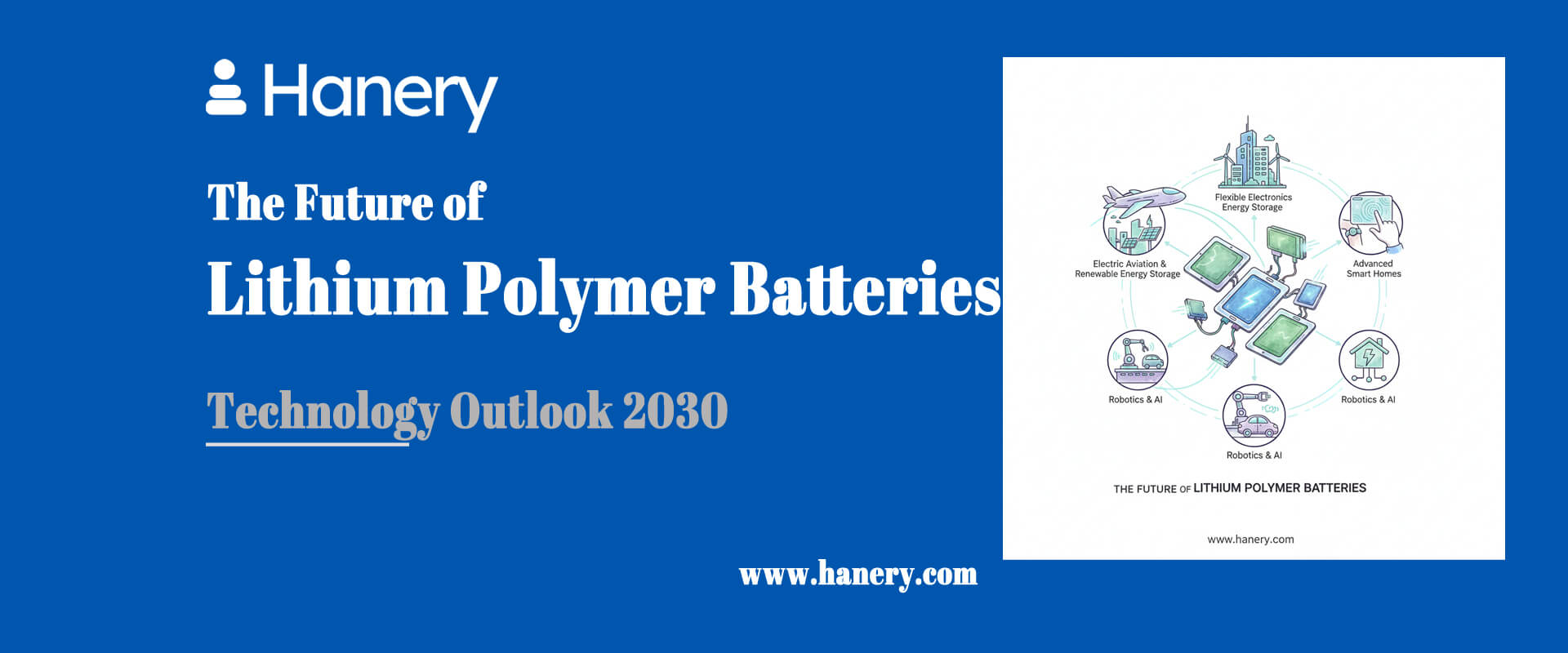
The innovations listed above will do more than just improve battery life; they will enable entirely new categories of devices that are currently impossible.
- AR/VR Glasses: Currently limited by heavy, short-lived batteries. With 500 Wh/kg silicon-anode cells, AR glasses will become as light as prescription frames, enabling all-day wear.
- eVTOL (Flying Taxis): Vertical takeoff requires immense power density. High-voltage, semi-solid LiPo packs will provide the safety and power-to-weight ratio needed to make urban air mobility a reality.
- Autonomous Robotics: Robots will no longer need to charge for 4 hours to work for 1. Extreme fast charging will allow warehouse robots to run 23 hours a day, charging in brief 5-minute bursts during breaks.
Frequently Asked Questions
Will LiPo batteries still be used in 2030, or will they be replaced?
LiPo (pouch format) will absolutely still be used, but the chemistry inside will change. The pouch format is superior for space efficiency in portable devices. We will likely see “Solid-State Pouch Cells” rather than a total replacement of the format.
What is the difference between Solid-State and Semi-Solid batteries?
Solid-state has 0% liquid electrolyte. Semi-solid contains a small amount (5-10%) of liquid/gel to improve ion flow at the interface. Semi-solid is the practical bridge that will dominate the market before full solid-state becomes cheap enough.
Will batteries get smaller or just last longer?
Both. OEMs will split into two camps: those who keep the size the same to double runtime (Industrial/Medical), and those who shrink the battery to make ultra-thin devices (Consumer/Fashion).
Is Hanery developing Silicon Anode batteries?
Yes. We are currently testing Silicon-Carbon composite anodes that offer significantly higher capacity than standard graphite cells. These are available for custom OEM projects requiring high energy density.
How does AI help battery life?
AI helps by learning your usage patterns. It avoids keeping the battery at 100% (high stress) when you aren’t using it. It also predicts thermal spikes and throttles charging slightly to prevent damage, extending the total cycle life of the pack.
Are cobalt-free batteries less powerful?
Historically, yes. But new chemistries like LFMP (Lithium Ferromanganese Phosphate) and high-voltage spinel are closing the gap. By 2030, cobalt-free options will likely match current cobalt-based energy densities.
Can I upgrade my current device with a 2030 battery?
Likely no. New batteries often require new charging hardware (higher voltage, different currents) and physical dimensions. The innovation is usually integrated into new devices.
Will fast charging damage future batteries?
Much less than it does today. With new low-resistance tab designs and thermal management materials, future batteries will be designed specifically to handle 10C (6-minute) charging without the degradation we see now.
What is the “Digital Twin” technology?
It is a virtual computer model of your specific battery stored in the cloud. It simulates how your battery is aging based on real-world data, allowing for incredibly accurate health predictions and safety warnings.
Why is “Dry Coating” better for the environment?
It eliminates the need for toxic solvents like NMP. This means factories don’t emit hazardous fumes, and they don’t need massive energy-hogging ovens to dry the electrodes. It makes the battery manufacturing process significantly greener.
Summary & Key Takeaways
The road to 2030 is paved with breakthrough chemistry and intelligent engineering. The Lithium Polymer battery is shedding its limitations, transforming from a simple energy storage component into a smart, safe, and incredibly dense power source.
- Density is Doubling: Expect to see 500 Wh/kg by the end of the decade, driven by Silicon anodes and High-Voltage cathodes.
- Safety is Built-In: Semi-solid electrolytes and flame-retardant materials will make thermal runaway a relic of the past.
- Intelligence is Standard: Your battery will have a digital brain, optimizing its own life and charging speed via the cloud.
- Sustainability is Critical: The industry is moving toward ethical, cobalt-free, and solvent-free manufacturing.
At Hanery, we are excited to lead this charge. We are not just waiting for 2030; we are building it. Our commitment to R&D ensures that when these technologies mature, our OEM partners will be the first to deploy them. Whether you are building the next generation of drones, medical devices, or smart wearables, Hanery is the partner that keeps you powered for the future.
Engineer the Future with Hanery
Are you designing a product for the next decade? Don’t let yesterday’s battery technology hold you back. Partner with a manufacturer that is defining the future of energy.
Reach out for a consultation on our high-voltage roadmaps, semi-solid prototypes, and custom AI-ready battery solutions. Let’s build the future together.
Preparing for 2030 means securing your supply chain today. This requires navigating 9 Compliance Requirements for Exporting Li-Po Batteries to the EU Market, understanding 7 Factors Influencing Lead Times, and knowing 10 Key Factors to Consider When Choosing a Li-Po Battery Manufacturer.
Change log:
08/02/2026 Article posted.
15/05/2026 Added Related Articles.
Factory-Direct Pricing, Global Delivery
Get competitive rates on high-performance lithium batteries with comprehensive warehousing and logistics support tailored for your business.
Contact Info
- [email protected]
- +86 13414472012
- https://www.hanery.com/
- A15 Building, No.6 Xinfeng Road, Longcheng Street, Longgang District, Shenzhen, China