

Why Li-Po Batteries Are Preferred in High-Performance RC Models: The Ultimate Power Guide
In the adrenaline-fueled world of Radio Control (RC) hobbies, performance is the only metric that truly matters. Whether you are a pilot executing gravity-defying maneuvers with a 3D helicopter, a driver drifting a touring car at 60 mph, or a captain racing a hydroplane across a lake, the limiting factor is often the power source. For decades, the hobby was constrained by heavy, inefficient nickel-based batteries. Then came the revolution: Lithium Polymer (Li-Po) technology.
Today, Li-Po batteries are the undisputed kings of the RC world. They have transformed toy-grade gadgets into professional-grade machines capable of speeds and agility that were scientifically impossible just twenty years ago. But what exactly makes this chemistry so superior? Why does a soft, foil-wrapped pouch outperform a rigid steel cylinder in high-stress environments?
At Hanery, we are not just observers of this revolution; we are the architects behind it. As a leading Chinese manufacturer specializing in polymer lithium batteries, 18650 packs, and Lithium Iron Phosphate (LiFePO4) solutions, we understand the physics of power delivery. We engineer the cells that push the limits of what RC models can do. From our advanced R&D centers to our ISO-certified production lines, we focus on creating batteries that offer the perfect balance of raw power, safety, and longevity.
This comprehensive guide delves deep into the technical reasons why Li-Po batteries are the preferred choice for high-performance RC models. We will explore the science of C-rates, the engineering behind voltage stability, and the practical realities of managing high-energy-density power sources. Whether you are an RC veteran or an OEM looking to source the best packs for your new product line, this article is your definitive resource.
Table of Contents
Instant Power Delivery: The Burst Advantage
The fundamental difference between a leisurely Sunday drive and a high-stakes RC race is the demand for instantaneous power. Electric motors used in modern RC models—specifically brushless motors—are voracious beasts. They do not sip energy; they gulp it. When a pilot punches the throttle to pull a drone out of a freefall, the motor may demand a current spike that is 50 to 100 times the battery’s resting capacity.
Low Internal Resistance
The secret to meeting this demand lies in Internal Resistance (IR). Li-Po batteries, specifically those manufactured using the stacking method utilized by Hanery, have significantly lower internal resistance compared to cylindrical Li-Ion or NiMH cells.
- The Physics: Resistance acts as a bottleneck. High resistance restricts the flow of electrons and converts valuable energy into waste heat.
- The Li-Po Edge: Because Li-Po cells utilize large, flat sheets of anode and cathode material layered together, they offer a massive surface area for ion exchange. This “wide highway” allows electrons to rush out of the battery instantly with minimal friction.
For an RC car accelerating off the starting line, this low IR translates to immediate torque. There is no lag. The energy is available the millisecond the trigger is pulled. In contrast, a battery with higher resistance would struggle to deliver that burst, resulting in a sluggish start known as “cogging” or simply slow acceleration.
High Discharge C-Rates: The Need for Speed
If you look at a Li-Po battery label, you will see a large number followed by the letter “C” (e.g., 50C, 100C). This is the C-Rate, and it is the defining characteristic of high-performance RC packs.
Decoding the C-Rate
The C-rate is a multiplier of capacity that indicates the maximum safe continuous discharge current.
Max Current (Amps) = Capacity (Ah) x C-Rate
- Example: A 5000mAh (5Ah) battery with a 50C rating.
- Calculation: 5Ah x 50 = 250 Amps.
- Result: This battery can continuously deliver 250 Amps of current.
Li-Po vs. The Rest
To put this in perspective, a standard high-quality 18650 Li-Ion cylinder might have a C-rate of 5C to 10C. If you put that into a racing drone, the battery would overheat and likely fail within seconds. Li-Po technology is unique in its ability to support discharge rates of 100C or even 150C in burst scenarios.
This capability is vital for 3D Aerobatics. When a plane is hovering vertically (hanging on the prop), the motor is under immense load. The battery must sustain high amperage without the voltage collapsing. Hanery’s high-discharge series cells are specifically engineered with thicker current collectors and specialized electrolyte additives to survive these extreme discharge events without thermal runaway.
Not all C-rates are created equal. To see how these performance cells differ from standard electronics power, read our guide on 8 Key Differences: High-Rate vs. Standard Li-Po Batteries.
Light Weight: The Gravimetric Density King
In aviation and racing, weight is the enemy. Every gram of weight requires more energy to move, creating a parasitic loop where heavier batteries kill performance.
Gravimetric Energy Density
Li-Po batteries excel in Gravimetric Energy Density (Watt-hours per kilogram).
- Shedding the Shell: Traditional cylindrical batteries are housed in steel cans to contain the pressure of their liquid electrolyte. This steel adds significant weight but stores zero energy.
- The Pouch Solution: Li-Po batteries use a semi-solid gel polymer electrolyte. This allows them to be packaged in a lightweight aluminum-laminated foil pouch. By eliminating the heavy metal casing, Li-Po batteries achieve a far superior power-to-weight ratio.
For a competitive RC drone pilot, saving 50 grams on the battery pack can mean the difference between winning a race and coming in second. It improves the agility of the craft, allows for faster cornering, and reduces the strain on the motors. Even in RC rock crawling, where weight is sometimes added for traction, users prefer to add weight where they want it (low on the axles), rather than being forced to carry it in the battery tray.
High Cycle Readiness: Minimal Memory Effect
Historically, RC hobbyists struggled with the “Memory Effect” inherent in Nickel-Cadmium (NiCd) and Nickel-Metal Hydride (NiMH) batteries. If you didn’t fully discharge them before recharging, they would “remember” the shorter capacity, effectively shrinking your tank.
The Freedom of Lithium
Li-Po batteries have zero memory effect.
- Top-Up Anytime: You can fly for 2 minutes, land, charge the battery back to 100%, and fly again without damaging the capacity.
- Cycle Efficiency: This allows hobbyists to maximize their day at the track or field. You don’t need to spend hours discharging batteries to 0V before recharging them.
However, “Cycle Readiness” also implies managing the lifecycle. While Li-Po batteries are robust in usage, they are sensitive to how they are cycled. Hanery’s advanced manufacturing ensures that our cells have a stable Solid Electrolyte Interphase (SEI) layer, which protects the anode and allows for hundreds of high-stress cycles, provided the user respects the voltage limits (never below 3.0V).
Custom Size Support: Fitting the Unfittable
RC models come in all shapes and sizes, from microscopic “Tiny Whoop” drones to massive 1/5 scale desert trucks. Rigid cylindrical batteries (like AA or 18650) often simply don’t fit.
The Geometric Flexibility
Because the electrolyte in a Li-Po is a gel and the casing is a soft pouch, Hanery can manufacture batteries in virtually any dimension.
- Thin and Flat: We can make batteries as thin as a credit card for glider wings.
- Long and Narrow: “Stick” packs designed to slide into the narrow chassis of an AK-style Airsoft gun or a slim glider fuselage.
- Split Cells: Often called “Saddle Packs,” where the battery is split into two connected pouches to sit on either side of a drive shaft in an RC car for perfect weight balance.
This customization capability allows RC designers (OEMs) to build the model first and the battery second, rather than being forced to build a bulky model around a standard brick battery.
Voltage Stability Under Load: Preventing the Sag
Voltage is electrical pressure. When a motor demands current, the voltage of the battery naturally drops. This is called Voltage Sag. If the voltage drops too low, the receiver may brownout, causing the pilot to lose control of the model.
The Flat Discharge Curve
A high-quality Hanery Li-Po battery exhibits a remarkably flat discharge curve.
- Nominal Voltage: 3.7V per cell.
- Performance: Under load, a good Li-Po will hold its voltage above 3.5V for the majority of the run.
- The Difference: A lower-quality battery might sag instantly to 3.2V when the throttle is punched. This results in a noticeable drop in RPM (Revolutions Per Minute) of the motor.
In high-performance applications, voltage equates to RPM. A battery that holds 15V under load will spin a motor faster than a battery that sags to 13V. This voltage stability is why Li-Po powered cars have that “punchy” feel throughout the entire race, rather than getting sluggish halfway through.
Safety Considerations: The Volatile Reality
We must address the elephant in the room: Safety. Li-Po batteries are volatile. The very characteristics that make them powerful (low resistance, high energy density) also make them reactive.
The Risks
- Puncture: Because they are in soft pouches, a crash can puncture the cell. Lithium reacts with oxygen and moisture, leading to fire.
- Overcharge: Charging beyond 4.20V per cell causes chemical breakdown and gas generation (puffing).
Engineering Safety
At Hanery, safety is our priority. We utilize:
- Ceramic-Coated Separators: To prevent internal short circuits even at high temperatures.
- High-Purity Electrolytes: To reduce gas generation and swelling.
- Tab Reinforcement: Ultrasonic welding of tabs to ensure they don’t break under the high vibration of RC use.
While Li-Po batteries require respect and proper handling (never charge unattended!), the performance benefits outweigh the risks for the enthusiast community, provided quality manufacturing standards are met.
Fraudulent specs are a major fire risk in the RC market. Learn the 8 Ways to Verify the Authenticity of Li-Po Battery Cell Capacities to protect your models and investment.
Charging Requirements: The Balancing Act
Li-Po batteries require sophisticated charging protocols compared to the simple “wall wart” chargers of the past.
Balance Charging
A Li-Po pack consists of multiple cells in series (e.g., a 3S pack has 3 cells). It is critical that all cells remain at the exact same voltage.
- The Drift: Over time, cells can drift apart. If one cell is at 4.0V and another is at 4.2V, continuing to charge the pack will overcharge the high cell, leading to fire.
- The Solution: Li-Po batteries have a dedicated Balance Lead (usually a JST-XH connector). Smart chargers use this to monitor and adjust individual cells, ensuring the pack remains perfectly synchronized.
Balancing is the secret to pack longevity. For a deep technical analysis, see our article on Why Li-Po Batteries Need Balancing and How Balancers Work.
Storage Charging
Unlike other chemistries, Li-Po batteries should not be stored full. Storing a Li-Po at 100% (4.2V) causes internal chemical stress and swelling. They must be discharged to a Storage Voltage (approx. 3.80V – 3.85V per cell) if not being used for more than a few days. This maintenance requirement is a trade-off for their high performance.
Flight / Car / Boat Comparisons: Tailored Power
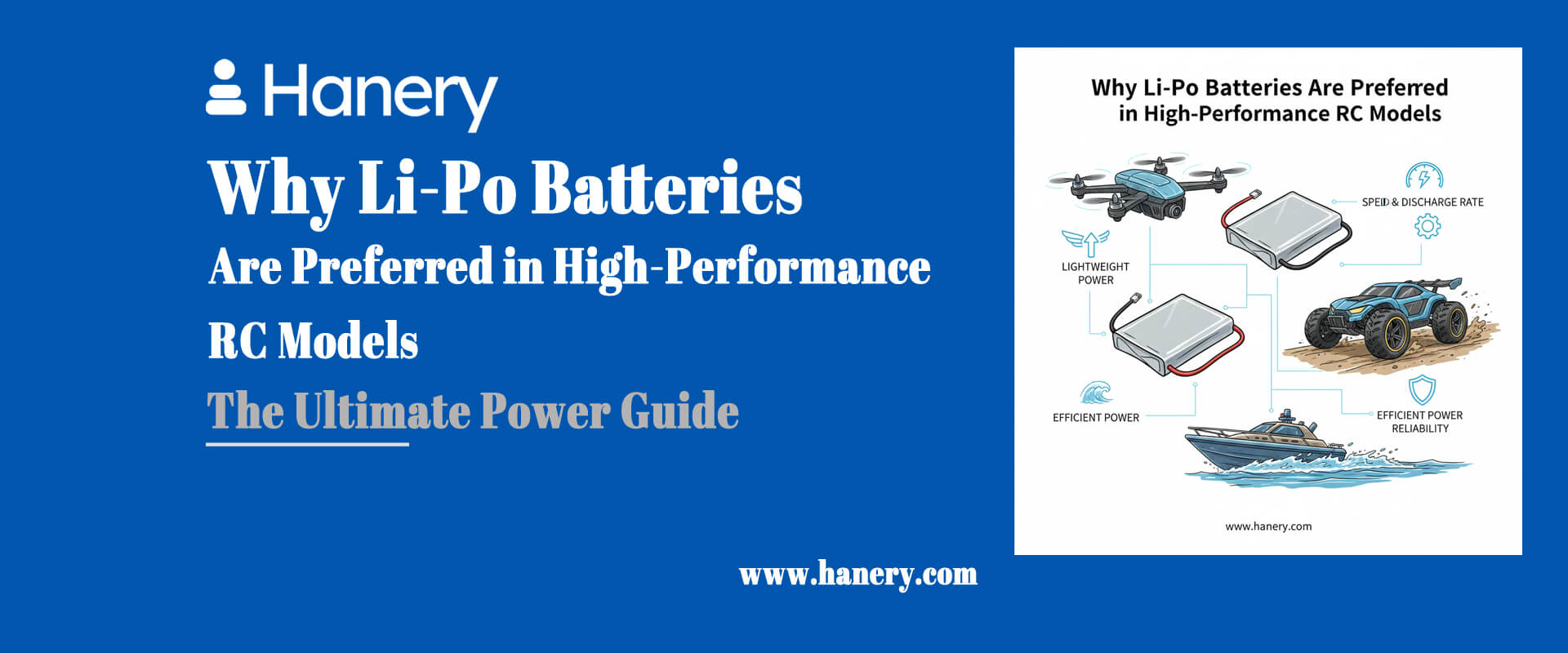
Different RC disciplines stress Li-Po batteries in different ways. Hanery offers tailored solutions for each.
RC Aircraft (Drones, Planes, Helis)
- Priority: Weight and Burst Power.
- Battery Type: High C-Rate (75C+), low weight. Often uses “High Voltage” (LiHV) technology charging to 4.35V for extra energy density.
RC Surface (Cars, Trucks, Buggies)
- Priority: Durability and Capacity.
- Battery Type: Hardcase Li-Po. These packs are encased in a tough plastic shell to protect the soft cells from impacts during jumps and crashes. Capacity is king here for long runtimes (5000mAh+).
RC Marine (Boats)
- Priority: Continuous High Amperage.
- Battery Type: Very High C-Rate. Boats operate under constant load (water resistance is constant, unlike a car that coasts). The battery must shed heat effectively to avoid thermal runaway inside a sealed hull.
Selecting the right voltage for your RC platform:
- Cars & Buggies: Explore our rugged 7.4V 2S 18650 Packs.
- Standard Drones: High-consistency 11.1V 3S Battery Packs.
- High-Speed UAVs: Performance-grade 22.2V 6S High-Voltage Modules.
Best Practices for RC Hobbyists
To get the most out of a Hanery Li-Po battery, enthusiasts should follow these golden rules:
- Break-In: Run the first few cycles gently. Do not go full throttle immediately on a brand new pack.
- Temperature: Pre-heat batteries in winter (keep them in pockets). Cold Li-Pos have high resistance and perform poorly.
- The 80% Rule: Never drain a Li-Po to 0%. Land or stop driving when you have used 80% of the capacity (approx. 3.7V resting voltage). Draining below 3.0V causes permanent chemical damage.
- Disposal: Never throw a Li-Po in the trash. Discharge it fully to 0V using a salt-water bath or light bulb discharger, then recycle it at a designated facility.
Comparison Chart: Li-Po vs. NiMH in RC
| Performance Feature | Li-Po (Lithium Polymer) | NiMH (Nickel-Metal Hydride) |
|---|---|---|
| Nominal Voltage | 3.7V per cell | 1.2V per cell |
| Energy Density | High (~200 Wh/kg) | Low (~70 Wh/kg) |
| Discharge Rate | Very High (Up to 100C+) | Low (Typically <10C) |
| Voltage Sag | Minimal (Punchy feel) | High (Sluggish feel) |
| Physical Shape | Flat, Pouch, Custom shapes | Rigid Cylindrical Sticks |
| Cycle Life | 300 - 500+ (High-stress) | 500 - 1000+ |
| Maintenance | Requires Balancing | Simple (Plug & Play) |
Frequently Asked Questions
What does “S” mean on a Li-Po battery (e.g., 3S, 4S)?
“S” stands for Series. It indicates how many cells are connected in a chain to increase voltage. Since one Li-Po cell is 3.7V:
- 2S = 7.4V
- 3S = 11.1V
- 4S = 14.8V
Higher voltage generally means higher motor RPM and more speed.
Can I use a Li-Po battery in my old RC car that came with NiMH?
Yes, but with caution. You must ensure your Electronic Speed Controller (ESC) has a Low Voltage Cutoff (LVC). If it doesn’t, you risk draining the Li-Po below 3.0V, killing the battery. You may also need to check if the motor can handle the higher voltage.
Why did my Li-Po battery puff up?
Puffing (swelling) occurs when the electrolyte inside the battery decomposes and generates gas. This is usually caused by over-discharging, overheating, or leaving the battery fully charged for too long. A puffed battery is damaged and should be retired.
Is it safe to charge Li-Po batteries inside the RC model?
No. Always remove the battery from the model to charge it. If the battery catches fire, you will lose your model (and potentially your house). Charge in a fire-retardant “LiPo Sack” or an ammo can on a non-flammable surface.
What is the difference between Softcase and Hardcase Li-Po?
The internal cells are the same. A Softcase is wrapped in shrink wrap to save weight (used in planes/drones). A Hardcase is inside a plastic box to protect against impact (used in cars/trucks).
Can I increase the flight time of my drone with a bigger battery?
Yes, but there is a point of diminishing returns. A bigger battery adds weight. Eventually, the extra energy is used just to lift the extra weight, and the flight characteristics become sluggish.
How many cycles will a Hanery Li-Po last?
With proper care (storage charging, never over-discharging), a high-quality Li-Po can last 300 to 500 cycles. However, extreme competition racing may degrade packs faster due to the immense heat stress.
What is Internal Resistance (IR) and should I measure it?
IR measures the battery’s “friction.” Lower is better. As a battery ages, IR increases, causing it to run hotter and deliver less power. Many smart chargers can measure IR. It is a great way to track the health of your packs.
Can I parallel charge Li-Po batteries?
Yes, if you are experienced. You can charge multiple batteries at once to save time, but they must have the same cell count (e.g., all 3S) and should be at similar voltage levels before connecting them.
Does Hanery offer custom Li-Po manufacturing for OEM RC brands?
Absolutely. We specialize in OEM/ODM services. We can customize the C-rate, capacity, dimensions, cable types, and branding to create the perfect battery line for your RC brand.
Summary & Key Takeaways
The dominance of Lithium Polymer batteries in the RC world is not a trend; it is a technological necessity. The physics of high-performance flight and racing demands a power source that can release massive energy instantly, hold voltage under load, and do it all without weighing the vehicle down.
- Performance: Li-Po offers the highest C-rates and lowest internal resistance, translating to explosive speed and torque.
- Customization: The pouch format allows for infinite shapes and sizes, fitting sleek aerodynamic fuselages and balanced chassis layouts.
- Responsibility: With great power comes great responsibility. Proper charging, storage, and safety protocols are the price of admission for this level of performance.
At Hanery, we are committed to pushing the boundaries of what is possible in portable energy. Our batteries are found in the winners’ circles of RC competitions and in the hands of hobbyists worldwide. We combine advanced chemical engineering with rigorous quality control to deliver batteries that you can trust to power your passion.
Ready to Power Your Innovation?
Are you an RC manufacturer or a distributor looking for high-performance battery solutions? Don’t settle for generic cells. Partner with a manufacturer that understands the science of speed.
Contact Hanery Engineering Team Today. Reach out to us for R&D consultation, custom pack design, and OEM production quotes. Let’s build the power source that your models deserve.
Change log:
21/02/2026: Original RC power guide posted.
28/05/2026 Content Update:
- Fixed layout rendering issues for better readability.
- Added 2026 benchmarks for LiHV (High-Voltage) performance in FPV racing.
- Linked to 4 professional guides on Authenticity Verification, High-Rate Chemistry, and Active Balancing.
- Integrated direct shopping navigation for 2S-6S RC battery configurations.
Factory-Direct Pricing, Global Delivery
Get competitive rates on high-performance lithium batteries with comprehensive warehousing and logistics support tailored for your business.
Contact Info
- [email protected]
- +86 13414472012
- https://www.hanery.com/
- A15 Building, No.6 Xinfeng Road, Longcheng Street, Longgang District, Shenzhen, China
You May Like: