


How Charging Speed Affects Li-Po Battery Degradation: An Engineer’s Guide
In the modern era of instant gratification, waiting is the ultimate inconvenience. We stream movies instantly, download gigabytes of data in seconds, and naturally, we expect our batteries to charge just as fast. The marketing race for “Super Charging,” “Hyper Charging,” and “Flash Charging” has conditioned consumers and product designers alike to view charging speed as a primary feature. However, in the electrochemical world of Lithium Polymer (Li-Po) batteries, physics demands a toll for this speed.
For Original Equipment Manufacturers (OEMs), drone pilots, and industrial engineers, understanding the relationship between charging speed and battery degradation is not just about convenience—it is about economics and safety. A battery charged slowly might last for 800 cycles, providing years of reliable service. The same battery, force-fed energy at high speeds, might fail in fewer than 200 cycles, bloated and useless.
At Hanery, we design energy solutions that balance the market’s demand for speed with the immutable laws of chemistry. As a leading Chinese manufacturer specializing in polymer lithium batteries, 18650 packs, and Lithium Iron Phosphate (LiFePO4) solutions, we subject our cells to rigorous torture tests in our R&D labs. We have seen exactly what happens inside a cell when it is pushed beyond its limits.
This comprehensive guide explores the hidden costs of fast charging. We will dive deep into the microscopic phenomenon of lithium plating, analyze the thermal thermodynamics of high-current charging, and provide the data-driven best practices you need to extend the life of your power source. Whether you are designing a new medical device or managing a fleet of delivery drones, this article is your manual for battery longevity.
Table of Contents
Fast-Charging Risks: The Traffic Jam Analogy
To understand why fast charging causes damage, we must first visualize how a Li-Po battery works. Charging is the process of moving lithium ions (Li+) from the cathode (positive), through the electrolyte, and inserting them into the graphite anode (negative). This insertion process is called intercalation.
The Parking Garage
Imagine the graphite anode as a massive multi-story parking garage. The lithium ions are cars looking for a parking spot.
- Slow Charging (0.5C): The cars arrive slowly. They have plenty of time to drive up the ramps, find an empty spot deep in the structure, and park neatly. The garage fills up efficiently and safely.
- Fast Charging (2C+): The cars arrive in a massive, chaotic wave. The entrance ramp gets clogged. Cars cannot get to the upper levels fast enough.
The Consequence
When the ions cannot intercalate into the anode structure fast enough, they pile up at the “entrance” (the surface of the anode). This congestion causes two primary issues:
- Mechanical Stress: The rapid influx forces the graphite layers to expand violently, causing microscopic cracking in the electrode structure.
- Chemical Instability: The high current creates a voltage potential that encourages side reactions, specifically the decomposition of the electrolyte, which leads to gas generation (swelling).
Lithium Plating Concerns: The Irreversible Damage
The most severe consequence of charging too fast is Lithium Plating. This is a phenomenon that haunts battery engineers because it represents permanent, irreversible damage and a significant safety hazard.
How Plating Occurs
When charging current exceeds the diffusion rate of the anode (the speed at which ions can move into the graphite), the ions accumulate on the surface of the anode. Instead of becoming part of the electrochemical storage system, they revert to their metallic form. They effectively plate the surface of the anode with metallic lithium.
Why It Is Dangerous
- Capacity Loss: The lithium that has plated onto the surface is “dead.” It can no longer participate in the charging/discharging process. This results in an immediate and permanent drop in battery capacity.
- Dendrite Formation: This metallic lithium does not form a smooth sheet; it grows in jagged, needle-like crystals called dendrites.
- These dendrites grow sharp enough to puncture the internal separator (the thin plastic wall between anode and cathode).
- If the separator is pierced, it creates an internal short circuit. This leads to self-discharge, excessive heat, and in extreme cases, thermal runaway (fire).
Hanery Warning: Lithium plating is most likely to occur when fast charging is combined with low temperatures. Never fast charge a cold battery.
Heat Generation: The Physics of Resistance
Speed generates friction, and in electricity, friction is Resistance. Every battery has an internal resistance (R). When you push current (I) through that resistance, you generate heat (P) according to Joule’s Law:
P = I²R
The Exponential Rise
Notice that the current (I) is squared. This means a small increase in charging speed leads to a massive increase in heat.
- 1C Charge: Generates X amount of heat.
- 2C Charge: Generates 4X amount of heat.
- 3C Charge: Generates 9X amount of heat.
The Damage Done
Excessive heat during charging (above 45°C) triggers chemical degradation:
- SEI Breakdown: The Solid Electrolyte Interphase (SEI) layer on the anode begins to decompose and reform. This consumes active lithium and thickens the layer, increasing internal resistance further.
- Binder Failure: The glue holding the electrode materials to the metal foils can weaken, leading to delamination (separation) of the internal layers.
- Electrolyte Oxidation: The heat accelerates the breakdown of the organic solvents, creating gas pockets that cause the battery to swell.
Cycle Life Reduction: The Cost of Speed
Manufacturers often rate Li-Po batteries for “500 Cycles.” However, there is always an asterisk next to that number. That rating is valid only under standard charge/discharge conditions (usually 0.5C Charge / 0.5C Discharge).
The Degradation Curve
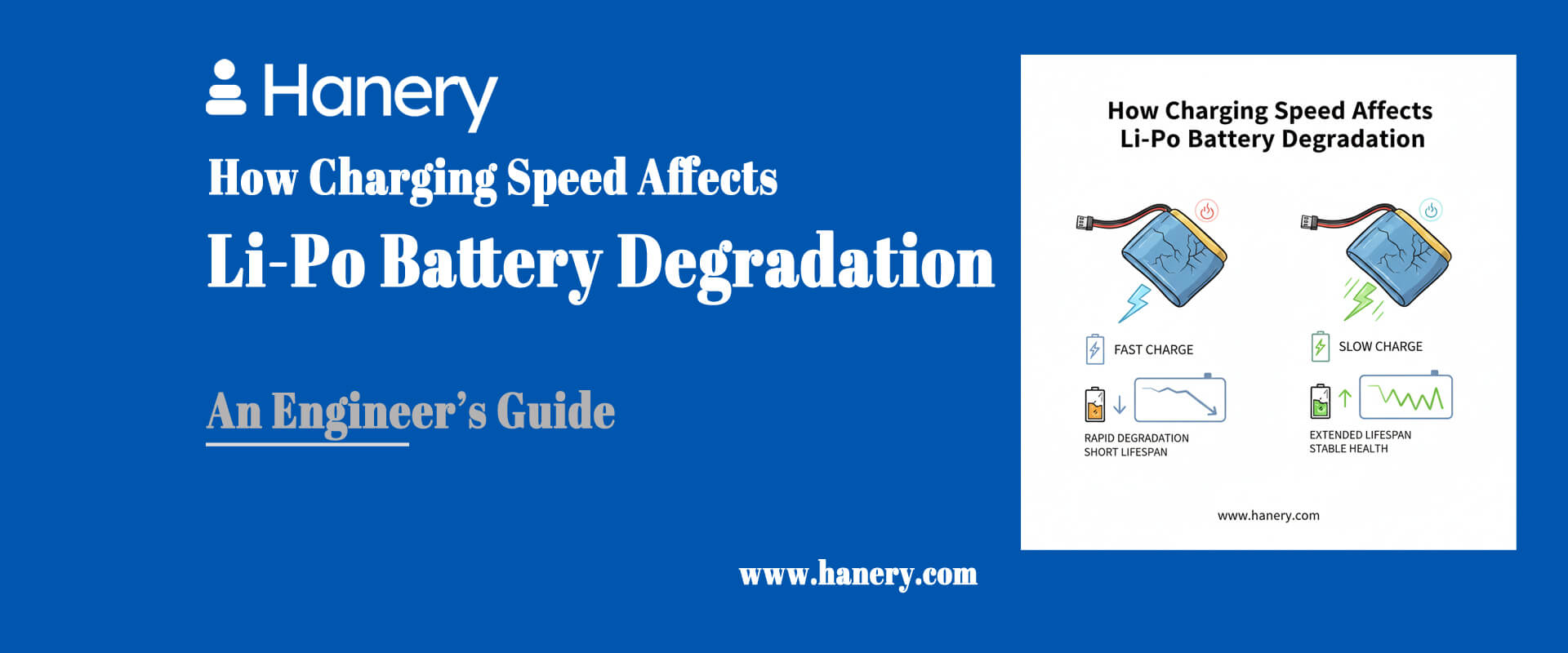
Fast charging dramatically steepens the degradation curve.
- Standard Charging (0.5C): The battery degrades linearly. You lose perhaps 0.05% capacity per cycle. After 500 cycles, you have 80% capacity left.
- Fast Charging (2C): The battery degrades exponentially. The combination of heat, micro-cracking, and plating accelerates the loss. You might hit 80% capacity in just 150 to 200 cycles.
For a drone pilot, this means replacing expensive flight packs three times as often. For an OEM, it means your device’s battery life might become unacceptable to the user just six months after purchase, leading to warranty claims and brand damage.
Speed costs longevity. To understand how to balance these two factors for heavy-duty projects, consult our 13 Considerations for Li-Po Battery Cycle Life in Heavy-Duty Applications.
Manufacturer Limits: Reading the Datasheet
Every Hanery battery comes with a datasheet specifying the Maximum Charge Current. It is vital to understand the difference between “Standard” and “Maximum.”
Standard Charge Current (0.2C - 0.5C)
This is the recommended rate for maximum longevity.
- Scenario: Charging a 5000mAh battery at 2.5 Amps (0.5C).
- Result: The battery stays cool, the ions intercalate smoothly, and the cycle life is maximized.
Maximum Charge Current (1C - 5C)
This is the “Emergency” or “Performance” rate.
- Scenario: Charging a 5000mAh battery at 5 Amps (1C) or higher.
- Nuance: Just because the datasheet allows 2C charging does not mean it is good for the battery. It means the battery will not explode at 2C. It does not guarantee it will last 500 cycles at that rate.
- High-Power Cells: Some specialized Hanery cells (like those for racing drones) utilize thinner electrodes and special electrolytes to handle 5C charging, but they inherently have shorter lifespans than standard energy cells.
Slow Charging Benefits: The Saturation Soak
While fast charging is stressful, slow charging is restorative. It allows for a deeper, more complete saturation of energy.
The CV Phase Advantage
Li-Po charging uses a Constant Current / Constant Voltage (CC/CV) profile.
- Fast Charge: The battery hits the peak voltage (4.2V) very quickly because the high current spikes the voltage. The charger switches to CV mode early. The result is a battery that is “70% full” quickly, but takes a long time to fill the last 30%.
- Slow Charge: The voltage rises gradually. The battery stays in the Constant Current phase longer, allowing ions to deeply penetrate the anode structure.
- Balancing: Slow charging gives the passive balancing circuit in the BMS (Battery Management System) more time to equalize the cell voltages. This ensures the pack remains perfectly balanced, which is critical for safety.
Precise voltage detection is the only way to safely manage the saturation phase. See Why Accurate Voltage Monitoring Matters in Li-Po Applications.
High-Power Charger Dangers: The Mismatch
In the USB-C era, we are used to plugging anything into any port. However, using a high-wattage charger on a small Li-Po battery can be disastrous if the charging circuit is not properly regulated.
The "Dumb" Charger Risk
If you connect a raw Li-Po battery (e.g., a drone pack) to a high-amperage power supply without setting the current limit correctly:
- The Overshoot: A 100W charger can dump 20 Amps into a small 1000mAh battery (a 20C rate!).
- The Failure: The battery tabs will act like fuses and melt. The electrolyte will vaporize instantly, puffing the pack and potentially causing a rupture and fire.
Hanery Advice: Always ensure your charger is set to the specific capacity of the battery. Just because your charger can do 10 Amps doesn’t mean your battery wants 10 Amps.
C-Rate Recommendations: Rules of Thumb
How fast should you charge? Here are Hanery’s engineering recommendations based on battery type.
Standard Li-Po (Consumer Electronics)
- Recommended: 0.5C
- Max: 1C
- Example: For a 2000mAh headset battery, charge at 1000mA (1A).
High-Discharge Li-Po (Drones / RC)
- Recommended: 1C
- Max: 2C – 3C (Only if specified on label)
- Example: For a 5000mAh racing pack, charge at 5A. In a rush, you can charge at 10A, but expect reduced life.
Ultra-Thin / High Density Cells
- Recommended: 0.2C – 0.5C
- Reason: These cells have very dense internal structures that make ion movement slower. Fast charging them causes rapid swelling.
Real-World Test Results: The Data Speaks
To illustrate the impact, Hanery’s R&D department conducts lifecycle tests on identical batches of 5000mAh Polymer Cells.
The Data Set
Three groups of batteries were cycled from 3.0V to 4.2V repeatedly until they dropped to 80% capacity.
- Group A: Charged at 0.5C (Slow)
- Group B: Charged at 1.0C (Standard)
- Group C: Charged at 3.0C (Fast)
The Results
- Group A (0.5C): Reached 650 Cycles before hitting 80% capacity. The cells showed minimal swelling.
- Group B (1.0C): Reached 480 Cycles. Slight swelling observed near end of life.
- Group C (3.0C): Failed at 140 Cycles. Several cells showed significant puffing and internal resistance had doubled.
Conclusion: Increasing charge speed from 1C to 3C reduced the useful life of the battery by more than 70%.
Safe Charging Habits: The Longevity Checklist
To get the most out of your Hanery Li-Po batteries, adopt these habits:
- Plan Ahead: Charge the night before or the morning of use so you can use a slow 0.5C or 1C rate. Avoid the “panic charge” at the field.
- Temperature Matters: Never charge a cold battery (<10°C). Warm it up first. Never charge a hot battery (>40°C) straight off a flight. Let it cool down.
- Balance Always: Always connect the balance lead. An unbalanced fast charge is a recipe for fire.
- Monitor: Never leave fast-charging batteries unattended. The risk of failure is highest during high-current input.
Comparison Chart: Charge Rate vs. Degradation Factors
| Charge Rate | Heat Generation | Lithium Plating Risk | Cycle Life Impact | Use Case |
|---|---|---|---|---|
| 0.2C (Slow) | Very Low | None | Minimal (Best Life) | Initial Formation, Storage Recovery |
| 0.5C (Standard) | Low | Very Low | Low | Daily Charging, Overnight |
| 1.0C (Fast) | Moderate | Low (if warm) | Moderate | Standard field charging |
| 2.0C (High) | High | Moderate | High (25% reduction) | Urgent turnaround needed |
| 5.0C (Extreme) | Very High | Severe | Critical (70%+ reduction) | Emergency use only |
Frequently Asked Questions
Is it bad to charge my battery at 0.1C (very slowly)?
No, it is not “bad,” but it is unnecessary. Extremely slow charging (like 0.1C) takes 10+ hours and doesn’t offer significant benefits over 0.5C. However, it is very safe and ensures deep saturation.
My battery says “5C Charge Rate” on the label. Should I use it?
That label indicates the maximum safety limit, not the recommended daily rate. Charging at 5C is possible, but it will degrade the battery rapidly. Treat it as a maximum limit, not a target.
Does fast charging affect capacity for that specific cycle?
Yes. Fast charging often results in a slightly undercharged battery. The charger hits 4.2V quickly and terminates before the saturation phase is complete. You might only get 90-95% of the true capacity compared to a slow charge.
Can I use a cooling fan while fast charging to prevent damage?
Cooling helps prevent electrolyte degradation, but it does not prevent lithium plating. Plating is caused by the ion traffic jam, not just heat. So while a fan helps, it doesn’t make fast charging “safe” for the chemistry.
Why does my phone fast charge without dying in a month?
Phones use highly specialized cells and sophisticated Battery Management Systems (BMS). The BMS throttles the speed based on temperature and voltage (step-charging). It only fast charges from 0% to 50%, then slows down significantly. Raw Li-Po packs (like for drones) rarely have this logic.
Is 1C considered fast charging?
In the modern context, 1C is considered the “Standard” rate. It takes about 1 hour. “Fast” is generally defined as anything above 1C. “Slow” is anything below 0.5C.
Does wireless charging damage batteries?
Wireless charging generates excess heat due to induction inefficiency. This heat transfers to the battery sitting right behind the coil. If the heat is excessive (>40°C), it will degrade the battery faster than wired charging.
Can I fast charge a swollen battery?
Absolutely not. A swollen battery has internal gas and damaged layers. Fast charging generates heat and pressure, which could cause the weakened pouch to rupture and ignite.
Why do old batteries take longer to charge?
As a battery ages, its internal resistance increases. This causes the voltage to spike quickly during charging, forcing the charger into the Constant Voltage (slow) phase much earlier. The battery spends more time trickling and less time in the bulk current phase.
How does Hanery ensure fast-charge capability?
We use specialized anode materials (like artificial graphite with optimized porosity) and lower-viscosity electrolytes in our high-power cells. This reduces the risk of plating, allowing for higher charge rates than standard generic cells.
Summary & Key Takeaways
The allure of fast charging is undeniable, but it is not free. It is a trade-off between Time and Lifespan. Every time you force electrons into a battery at high speed, you are paying a micro-tax on the battery’s future performance.
- Physics is the Limit: Lithium ions have a speed limit. Exceeding it causes traffic jams (plating) and friction (heat).
- Heat Kills: The heat generated by fast charging cooks the internal chemistry, leading to swelling and capacity loss.
- 1C is Safe: For most applications, 1C is the perfect balance. It charges in one hour and preserves the battery health.
- Patience Pays Off: If you can afford to wait, charging at 0.5C will significantly extend the ROI of your battery packs.
At Hanery, we build batteries that are tough enough to handle the demands of the real world. However, we also believe in empowering our partners with the knowledge to protect their investment. By adopting a conservative charging strategy, you ensure that your Hanery power solutions deliver reliable performance for years, not just months.
Our factory ensures every cell can handle its rated C-rate through a rigorous 100% Individual Cell Grading and Testing process.
Build a Better Charging Strategy
Are you an OEM designing a device with fast-charging requirements? Don’t let thermal management be an afterthought.
Contact Hanery Engineering Team Today. Reach out for a consultation on custom cell chemistry optimized for fast charging, and let us help you design a charging profile that balances speed with safety and longevity.
Change log:
26/02/2026: Original engineering analysis posted.
30/05/2026 Content & Layout Update:
- Fixed duplicate content rendering issues.
- Integrated 2026 benchmarks for Lithium Plating thresholds.
- Linked to specialized guides for Cycle Life and Voltage Monitoring.
- Added Dataset Schema for C-rate vs Degradation metrics.
Factory-Direct Pricing, Global Delivery
Get competitive rates on high-performance lithium batteries with comprehensive warehousing and logistics support tailored for your business.
Contact Info
- info@hanery.com
- +86 13414472012
- https://www.hanery.com/
- A15 Building, No.6 Xinfeng Road, Longcheng Street, Longgang District, Shenzhen, China