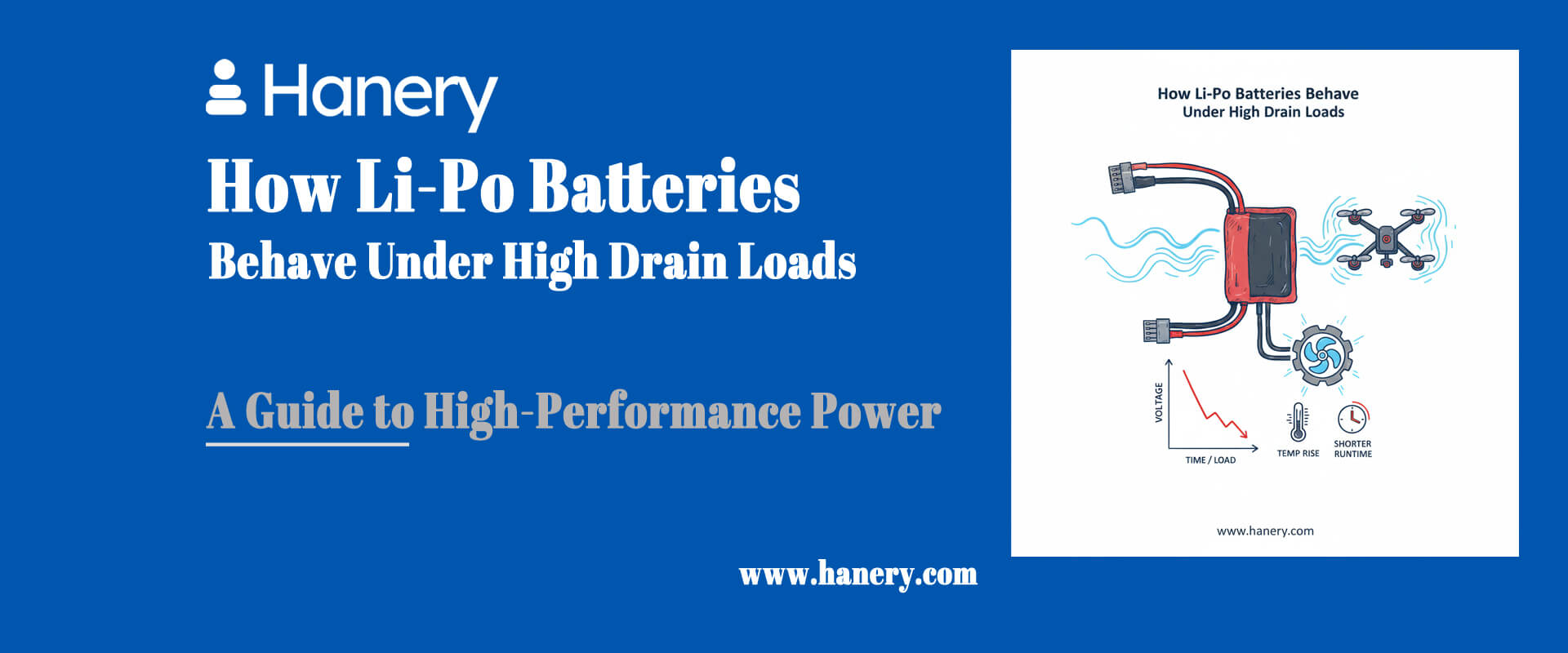



How Li-Po Batteries Behave Under High Drain Loads
In the quiet hum of a smartwatch or the standby mode of a tablet, a battery lives a gentle life. The flow of energy is a trickle, barely stressing the internal chemistry. But in the world of high-performance electronics—racing drones screaming at 100 mph, power tools tearing through concrete, or medical defibrillators delivering a life-saving shock—the battery faces a violent storm. This is the realm of High Drain Loads.
For Original Equipment Manufacturers (OEMs), product designers, and power enthusiasts, understanding how a Lithium Polymer (Li-Po) battery behaves under these extreme conditions is critical. A battery that looks perfect on a spec sheet can fail catastrophically when asked to deliver 50 Amps of current in a split second. The voltage sags, the temperature spikes, and the chemical structure begins to degrade.
At Hanery, we specialize in taming this storm. As a leading Chinese manufacturer of polymer lithium batteries, 18650 packs, and Lithium Iron Phosphate (LiFePO4) solutions, we engineer high-discharge cells designed to survive the punishment of high-drain applications. We know that “high performance” isn’t just about capacity; it’s about holding steady when the throttle is wide open.
This comprehensive technical guide dives deep into the physics of high-drain discharge. We will explore why voltage drops under load, how heat kills efficiency, and how to interpret discharge curves to choose the perfect battery for your demanding application. Whether you are building an eVTOL aircraft or a cordless vacuum cleaner, this guide provides the engineering insights needed to power your innovation.
Table of Contents
What "High Drain" Actually Means
The term “High Drain” is relative. A 1-Amp load is high drain for a tiny watch battery, but negligible for a car battery. In the context of Lithium Polymer technology, high drain is defined by the C-Rate.
The C-Rate Definition
The C-Rate is a measure of the discharge current relative to the battery’s capacity.
- 1C: A current that empties the battery in 1 hour. (e.g., 5A for a 5000mAh battery).
- High Drain: Generally defined as anything above 5C to 10C.
- Ultra-High Drain: Anything above 30C.
The Application Context
- Low Drain (0.2C – 1C): Bluetooth speakers, laptops, IoT sensors. The chemistry is relaxed.
- Medium Drain (3C – 10C): E-bikes, hoverboards. The battery gets warm but stays stable.
- High Drain (20C – 100C): FPV racing drones, RC cars, jump starters. The battery is pushed to its chemical and thermal limits.
When a battery is subjected to high drain, the internal ions must move at breakneck speeds. This is not a steady flow; it is a rush hour traffic jam on a molecular level.
Voltage Drop Behavior: The Instant Sag
The most immediate symptom of a high-drain load is Voltage Sag. When you demand massive current, the voltage at the battery terminals drops instantly.
The Physics of V-Drop
- This is governed by Ohm’s Law:
$$V_{terminal} = V_{internal} - \left(I_{load} \times R_{internal}\right)$$
- I_load: The current you are pulling.
- R_internal: The battery’s Internal Resistance.
If you pull 100 Amps from a battery with 0.005 Ohms (5mΩ) of resistance, you lose 0.5 Volts instantly just to internal friction.
- Resting Voltage: 16.8V (4S Pack).
- Under Load: 16.3V.
The "Bounce Back"
Crucially, this drop is usually temporary. When the load is removed (you let off the throttle), the voltage “bounces back” or recovers. However, if the sag is deep enough to hit the device’s Low Voltage Cutoff (LVC), the device will shut down mid-operation, even if the battery still has 80% capacity remaining. This is why low internal resistance (Low IR) is the holy grail of high-drain batteries.
Heat Generation: The Efficiency Killer
Energy cannot be created or destroyed. The energy lost to internal resistance during voltage sag doesn’t disappear; it turns into Heat.
Joule Heating (I²R)
The formula for power loss is P = I²R. Note that Current (I) is squared.
- 20A Load: Generates X heat.
- 40A Load: Generates 4X heat.
- 100A Load: Generates 25X heat.
In a high-drain scenario, a battery can heat up from 25°C to 80°C in less than 3 minutes.
- The Danger Zone: Above 60°C, the electrolyte begins to decompose. Above 80°C, the separator can melt, leading to thermal runaway.
- The Hanery Solution: For high-drain cells, we use wider, thicker internal tabs and highly conductive copper foils to minimize $R$ and act as internal heatsinks, wicking heat out of the core to the surface where it can dissipate.
Cycle Degradation: The Cost of Power
Using a battery at high drain significantly shortens its lifespan. While a laptop battery (low drain) might last 800 cycles, a racing drone battery (high drain) might be “tired” after just 150 cycles.
Mechanical Stress
The rapid movement of lithium ions into and out of the anode causes the graphite structure to expand and contract violently. This “breathing” creates micro-cracks in the electrode material.
- Island Formation: Parts of the active material can crack off and become electrically isolated. They are still inside the battery, but they can no longer store energy. This manifests as capacity loss.
SEI Thickening
The high heat generated during discharge accelerates the breakdown of the Solid Electrolyte Interphase (SEI) layer. The layer thickens, increasing resistance further, which causes more heat and more sag in a vicious cycle.
High C-Rate Stress: Beyond the Label
Marketing labels often claim “100C” or “150C” discharge rates. In reality, sustained discharge at these rates is often physically impossible without destroying the pack.
Continuous vs. Burst
- Continuous Rating: The current the battery can deliver from 100% to 0% without overheating. Realistically, few packs can handle true 50C continuous.
- Burst Rating: The current the battery can deliver for 3 to 5 seconds (e.g., a takeoff or a punch-out). This is typically double the continuous rate.
Hanery Engineering Truth: A “100C” label often really means “100C Burst / 50C Continuous.” Pushing a battery to its burst limit for more than a few seconds will cause voltage collapse and permanent damage.
Load Peaks and Dips: The Dynamic Profile
High-drain applications rarely draw constant current. They are dynamic.
- Drone: Hover (20A) -> Punch-out (100A) -> Cornering (40A) -> Dive (5A).
- Power Tool: Spin up (50A) -> Drilling (30A) -> Stall torque (80A).
The Recovery Challenge
The battery chemistry must be agile enough to recover during the “dips” (low load periods). The electrolyte must redistribute ions quickly so they are ready for the next “peak.” High-quality Hanery cells utilize proprietary electrolyte additives that lower viscosity, allowing for faster ion equilibration during these brief rest periods.
Evaluating Discharge Curves: Reading the Data
To truly judge a high-drain battery, you must look at its Discharge Curve, not just its capacity.
The "Flat" Curve
- Good Battery: Holds a steady voltage (e.g., 3.7V – 3.6V) for most of the discharge, then drops off sharply at the end. This delivers consistent power to the motor.
- Bad Battery (High Sag): Voltage slopes down immediately and continuously. The drone feels punchy at the start but sluggish after 1 minute. Don’t rely on generic charts. Ensure your supplier provides a 9 Essential Components of a Professional Li-Po Battery Data Sheet to verify real-world voltage stability.
The Area Under the Curve
In high-drain applications, Watt-hours (Energy) is more important than Amp-hours (Capacity).
- Due to voltage sag, a 5000mAh battery discharged at 50C will deliver fewer Watt-hours than the same battery discharged at 1C. The voltage drop eats into the total usable energy.
Use Cases Requiring High Drain
Where is this technology essential?
- FPV Racing Drones: The most demanding application. Requires extreme burst current and low weight. FPV platforms demand more than just power; they demand precision. Read our breakdown of the 11 Essential Features of High-Performance LiPo Batteries for UAV Industries.
- Electric Jet (EDF) Models: Electric Ducted Fans are inefficient and draw massive continuous amps to generate thrust.
- Jump Starters: A small Li-Po pack must deliver 300-600 Amps for 2 seconds to crank a car engine.
- Power Tools: Cordless circular saws and grinders need high torque (current) to cut through material without stalling. Weight-to-power ratio is critical for ergonomic tools. Discover the 9 Reasons to Choose Li-Po Batteries for Lightweight Industrial Equipment.
- Airsoft Guns: High-speed motors need burst current to cycle the gearbox rapidly for high rates of fire.
Choosing Proper Pack Size: Oversizing for Safety
The best way to handle high drain is to oversize the battery capability.
The Overhead Rule
If your application demands 50 Amps continuous:
- Don’t pick a battery rated for exactly 50A (e.g., 2500mAh 20C). It will run hot and sag.
- Do pick a battery rated for 75A or 100A (e.g., 2500mAh 40C or 5000mAh 20C).
Having “headroom” keeps the battery operating in its efficient zone, reducing sag and extending lifespan. It is better to carry a slightly heavier battery that runs cool than a light battery that cooks itself.
Testing High-Drain Performance
How does Hanery verify high-drain specs? We use specialized DC Electronic Loads.
The Constant Power Test
Instead of constant current, we test at constant power (Watts). As voltage drops, current must increase to maintain power. This simulates real-world devices (like regulated drone power systems) that draw more amps as the battery gets empty.
Temperature Tracking
We tape thermocouples to the battery tabs and body. If the tab temperature exceeds 80°C or body temperature exceeds 60°C during the test, the battery fails the high-drain certification, regardless of whether it delivered the capacity.
Chart: Voltage Sag Comparison at 50A Load
| Battery Type | Internal Resistance | Resting Voltage (4S) | Voltage Under 50A Load | Sag | Performance Feel |
|---|---|---|---|---|---|
| High C-Rate (Hanery) | 2 mΩ | 16.8V | 16.7V | 0.1V | Locked-in, Powerful |
| Standard Li-Po | 10 mΩ | 16.8V | 16.3V | 0.5V | Good |
| Old / Low Quality | 30 mΩ | 16.8V | 15.3V | 1.5V | Soft, Sluggish |
| Wrong Spec (Low C) | 60 mΩ | 16.8V | 13.8V | 3.0V | Cutoff / Crash |
Frequently Asked Questions
Does high drain damage the battery permanently?
Yes, over time. High drain causes heat and mechanical stress that degrades the battery faster than low drain usage. However, using a properly rated high-C battery minimizes this damage.
Why does my battery puff after a high-speed run?
Puffing indicates the electrolyte boiled or decomposed due to excessive heat. This means you pushed the battery beyond its C-rate capability. You need a higher C-rate pack for that application.
Can I use a high-drain battery in a low-drain device?
Yes. A 100C battery will work perfectly fine in a low-power device (like a radio). It will just run very cool and efficient. The device only pulls the current it needs.
What is the difference between Burst and Continuous C-rate?
Continuous is what the battery can do until empty. Burst is what it can do for <5 seconds. Marketing often highlights the Burst number because it is bigger. Always check the datasheet for the Continuous rating.
How do I know if my battery is getting too hot?
If you cannot hold the battery comfortably in your hand (>50°C) after use, it is too hot. Ideally, a high-drain battery should come down warm (35-40°C), not hot.
Does the connector type matter for high drain?
Absolutely. Pushing 100 Amps through a small connector (like JST or XT30) will melt the plastic and cause a voltage drop. Use XT60, XT90, or EC5 connectors for high-current applications.
Why do high-drain batteries have thicker wires?
Thick wires (12AWG or 10AWG) lower the resistance of the cable. Thin wires would heat up and restrict current flow, causing voltage loss before the power even reaches the device.
Can “High Voltage” (LiHV) batteries help with sag?
Yes. LiHV batteries start at 4.35V per cell. Even if they sag, the voltage stays higher for longer compared to a standard 4.20V cell, delivering more total power (Watts).
Why does my voltage sag more in winter?
Cold electrolyte has higher resistance. In winter, even a high-C battery will act like a low-C battery until it warms up. Pre-heat your packs to 25°C before high-drain use.
How does Hanery test C-ratings?
We use a programmable DC load bank to discharge the battery at the claimed rate while monitoring temperature. If the battery capacity is delivered fully without exceeding 60°C, it passes the C-rating.
Summary & Key Takeaways
High-drain loads represent the ultimate stress test for battery technology. Success in this arena requires more than just capacity; it requires a low-resistance architecture capable of delivering massive electron flow without overheating.
- It’s All About Resistance: Low Internal Resistance (IR) is the key to preventing voltage sag and heat.
- Oversize for Longevity: Always choose a battery with a C-rating higher than your maximum load requirements to provide a safety buffer.
- Heat is the Enemy: Monitor post-run temperatures. Hot batteries are dying batteries.
- Voltage is Temporary: Don’t panic at voltage sag under load, but ensure it doesn’t dip below your device’s critical cutoff threshold.
At Hanery, we engineer our high-discharge series to thrive where others fail. By optimizing electrode density, tab width, and electrolyte chemistry, we provide the punchy, reliable power needed for the most demanding RC and industrial applications. When performance is paramount, trust the physics of a Hanery High-C battery. For high-torque and rapid burst applications, our High-Discharge 18650 Cells and 22.2V 6S Drone Modules are factory-balanced for minimum voltage sag.
Unleash the Power
Are you designing a high-performance device that demands instant torque and zero lag? Don’t let a weak battery hold you back.
Contact Hanery Engineering Team Today. Reach out for a consultation on our High C-Rate polymer series. Let us help you find the power source that matches your ambition.
Change log:
01/03/2026: Original technical breakdown on high-drain physics posted.
16/06/2026 Content Refresh:
- Integrated 2026 performance data for Silicon-Anode high-discharge cells.
- Added a structured Voltage Sag Comparison Dataset for engineering audits.
- Interconnected with UAV Industry Guides and Data Sheet standards to resolve orphaned content status.
- Added 5 new FAQs regarding high-C rate cell aging and connector thermal limits.
Factory-Direct Pricing, Global Delivery
Get competitive rates on high-performance lithium batteries with comprehensive warehousing and logistics support tailored for your business.
Contact Info
- info@hanery.com
- +86 13414472012
- https://www.hanery.com/
- A15 Building, No.6 Xinfeng Road, Longcheng Street, Longgang District, Shenzhen, China